New York Weeks 9 & 10
Post written by Claire Paterson, recipient of the Steven Campbell New York Scholarship
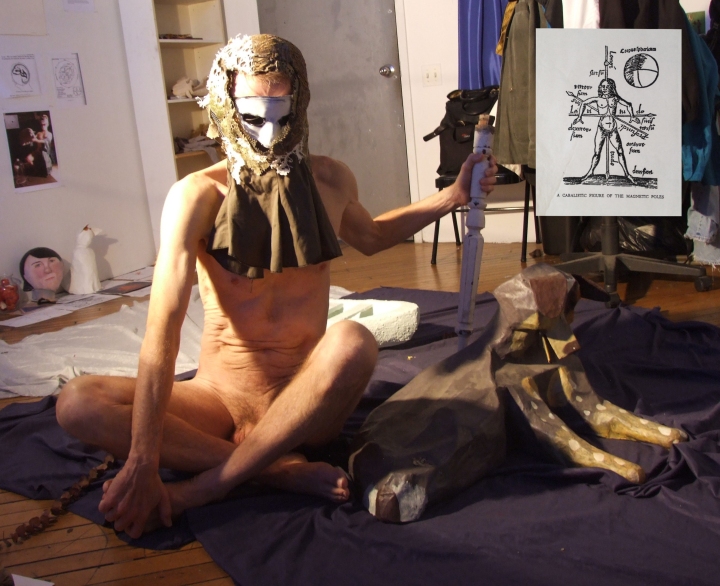
Pose improvised in collaboration with Emma Wylie and G.Paterson, with costume elements contributed by G.Paterson, and sculptural objects contributed by G.Paterson and Maartje Korstanje.
Happy New Year from New York, everyone!
After taking in some NY sights, and seeing in the New Year watching fireworks at Prospect Park with my 3 sisters, we were able to collaborate on some myth-making sessions together (unfortunately Rebecca had to return to Scotland, so wasn’t able to participate this time – but hopefully another opportunity will present itself soon!).
Below are some of the results from the collaborative sessions with G and Emma.
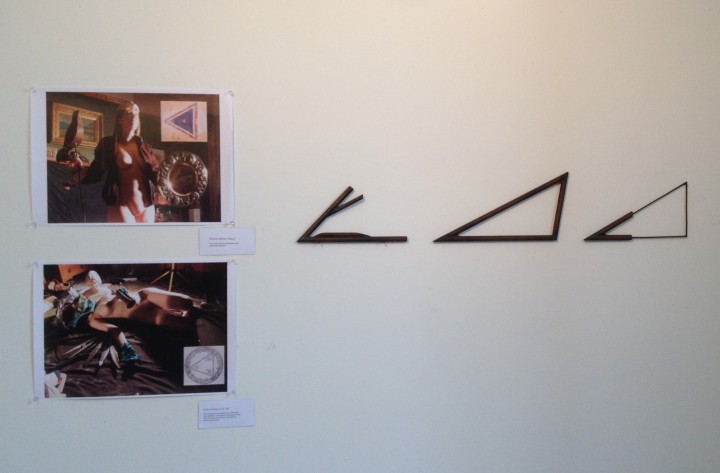
Pose improvised in collaboration with Emma Wylie, with costume elements contributed by G.Paterson, and metallic triangles contributed by Robert Picker.
Pose improvised in collaboration with Emma Wylie and G.Paterson, with costume elements contributed by G.Paterson.
Pose improvised in collaboration with Emma Wylie and G.Paterson, with costume elements contributed by G.Paterson.
Pose improvised in collaboration with Emma Wylie and G.Paterson, with costume elements contributed by G.Paterson, and sculptural objects contributed by G.Paterson and Maartje Korstanje.
Other highlights from weeks 9 & 10 in New York:
Tuesday December 27th
Today Irish resident Laura Fitzgerald hosted the ‘One artist, one work’ event in her studio, where she showed a screening of her performative video ‘Field Research II.’
The piece documented walks Laura took through the countryside in County Kerry, with her utilizing elements from nature to create a performative parody of the contemporary art-world (with sheep being critics, cows artists etc.).
As well as being hilarious, her work also explored in a more serious way issues related to the tension and friction often experienced when artistic life is counterpointed with a return to your own community roots.
Tuesday January 3rd
This afternoon G, Emma and I went to the Kerry James Marshall exhibition at the Met Breuer. The top two floors of the building contained his largest exhibition to date, featuring his monumental narrative paintings. Marshall has a lot in common with Steven Campbell – particularly in relation to his extensive referencing of the history of art, literature and philosophy, his use of parody and humour, and the often sinister undertones contained in the scenes he depicts.
I was also interested in his use of religious iconography, and his incorporation of symbols and various sign-systems into his compositions.
Next week, I’ll hopefully be posting up some images of finished paintings from my studio.
Post written by Claire Paterson, recipient of the Steven Campbell New York Scholarship
I’ve been in the studio most of the week, getting as much painting done as possible before all of my big sisters arrive in New York for New Year! Hoping for the Paterson sisters to collaborate on some of myth-making sessions – exciting times. Here are some other events/ highlights from this week:
Tuesday 13th December
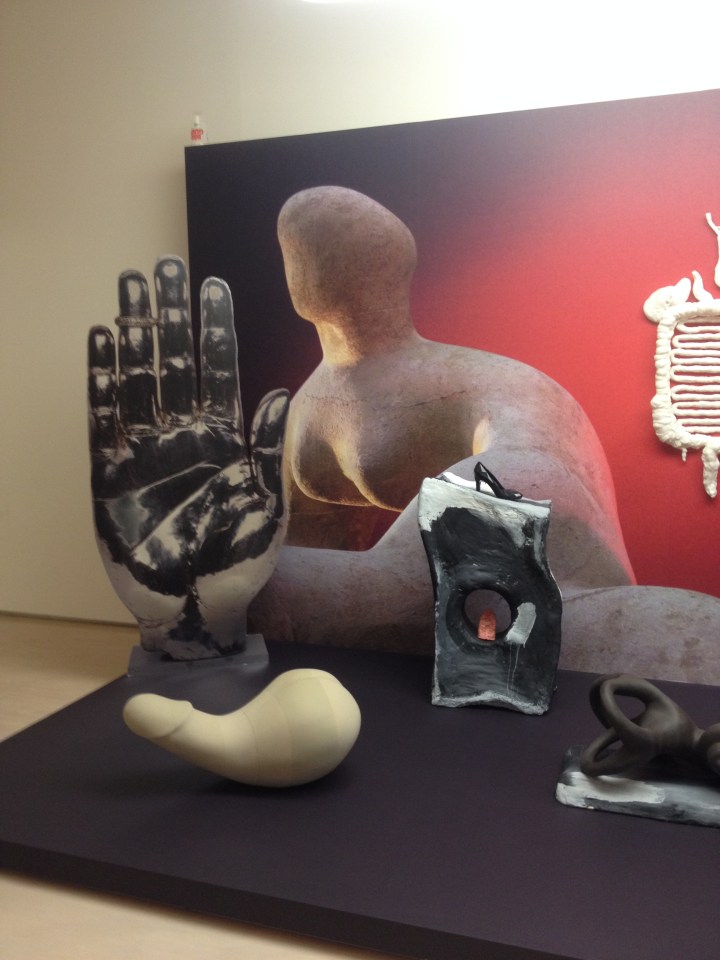
Maartje Korstange’s sculptures in my studio
Today ISCP resident Maartje Korstange, who previously contributed a sculpture to my collaborative myth-making project, came to visit me in my studio.
“Untitled”, 2009, cardboard, wood glue, wood, fishing gloves, polyurethane foam. Overview soloshow at Jan Cunen Museum. Photo: Gert Jan van Rooij
Utilizing a range of materials, Maartje shapes these visceral, organic sculptures whose forms feel both natural and familiar, but also distinctly other. When placed in either a gallery or outdoor location, I feel that these pieces transform the space around them, creating a strange new topography.
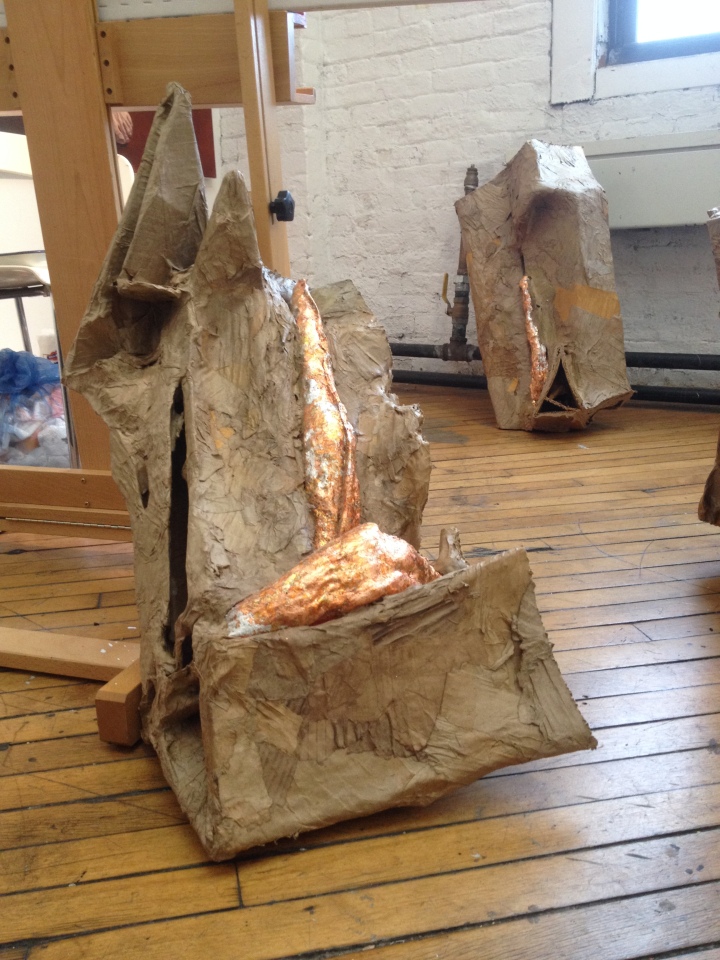
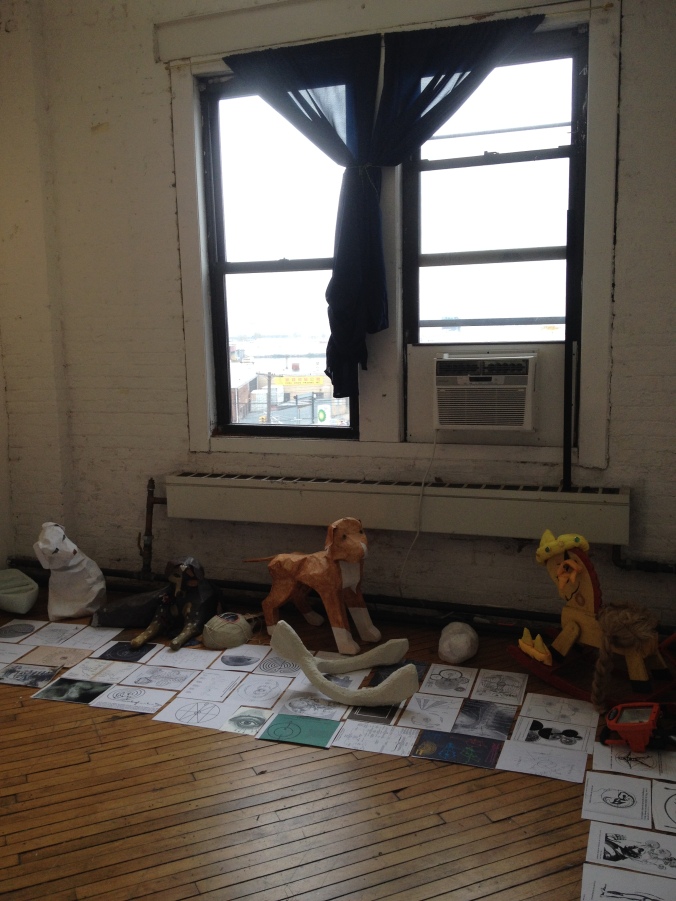
After discussing my project with me for a while, and seeing some of the results from recent photographic sessions, Maartje gave me yet more sculptures to use as props in my collaborations with models. Made from cardboard, glue, foam, and a finishing patina of gold-leaf and copper in sections, these fragments of a deconstructed larger sculpture have already changed the atmosphere in my studio, giving it the feel of a forest floor.
Maartje’s sculptures in my studio space
I was glad to hear that Maartje is interested in seeing her sculptures going on to have another life out-with their original meaning and context, and though she’s leaving for the Netherlands in a week or two, I hope to keep in touch and let her see more results from our collaboration.
Ruchama Noorda, Nachtelijke Dwaling #5, 2014, Performance – part of curator Julia Geerlings Nocturnal Wanderings project
In the evening, another ISCP resident – Julia Geerlings – came to visit me in my studio.
Julia is a freelance curator and writer based in Amsterdam and Paris, and like me, has an interest in performance, ritual, myth and spirituality, among other things. I enjoyed seeing some documentation of her NachtelijkeDwalingen (Nocturnal Wanderings) project, a performance program at Oude Kerk Amsterdam. Curated by Julia, this project involves inviting artists to the area around Oude Kirk, and encouraging them to create ‘new work concentrated in a nocturnal walking route,’ the ‘hidden, forgotten aspects’ of the surrounding environment shaping the artists’ responses.
Looking at the development of my own project, Julia has become the third person to suggest that I produce a catalogue or publication that outlines all of the stages of my myth-making process, with this possibly being shown alongside paintings & photographs in any potential exhibition.
Thursday 15th December
This morning I dropped in on G, who’s been spending most of the last week or so working on her soft sculpture project, ‘Post-partum Dogument’.
We also spent a lot of time discussing an email that the artist Elizabeth Kay sent me, where she talks about 2 particular images from one of my last blog posts.
G playing McCollum & Mullican’s ‘Your Fate’ Game
Here’s a quote from Elizabeth Kay’s email, where she discusses the above photo:
‘Claire, I was really struck by 2 images on your blog. This first one of your sister captures (for me) the essence of what you and some of the other artists you’ve described are involved with. Firstly, the picture is just beautiful and worthy of being painted. I’m struck by how the young woman with her sibylline smile is looking for meaning/significance/intelligence/guidance/ etc. etc. etc. in the game of chance. The dice actually seem suspended in the air above the strong colors which give the impression that some magical power is at work. The childlike stools and table behind her in this rather empty, light room dotted with strong primary colors evokes a child’s wonder and puzzle about how things work. The picture is not a picture of a new myth trying to reveal itself, but it is about the process of searching for one. That is what you and some of the other artists are doing – searching – and this lovely picture captures that profound reality.’
Sandra Bullock at Church Avenue subway stop
‘The next picture is just as compelling but with a very different feeling tone. The story you tell about the frenzied tabloid photographers going at each other says it all. In the photograph you took we see a truly lovely woman framed in hard metal. Her expression is rather lost. The horizontal white light reflection in the glass acts like a spear through her head. If you remove the blond head, the woman in white appears totally isolated. Then there is the sad irony of what you witnessed with the paparazzi. In a culture that has lost whatever unifying myths it once had, the deep-seated need for a ‘goddess’ has been pathetically and irrationally redirected to a Hollywood ‘star’, who is really just a human being like everyone else, except that she is ‘framed’ in this special way by the media. This is worth fighting for? Apparently so, since you saw it unfold before your eyes. No wonder you and your fellow artists are desperately seeking new myths.’
(quote provided by New Mexico artist Elizabeth Kay)
As G and I sat surrounded by the creative clutter of her latest soft-sculpture project, I read Liz’s observations out loud. Not only did her comments open my eyes to the strangeness and mystery contained in the photo of G playing ‘Your Fate,’ it also inspired a long conversation between us sisters about this search for meaning we’re both engaged in at the moment.
After reading Liz’s comments, I now want to paint that image of G at some point. G’s thinking of doing my portrait too, although what form this will take she’s not quite sure yet. Recently she’s been thinking about doing a series of portraits of artists who suffer from auto-immune and chronic pain conditions, hoping to link this to Shamanism. It is believed in some circles that fibromyalgia and chronic fatigue are the mark of the modern-day shaman, with shamans often becoming healers through mental or physical suffering.
She wants to include me in this series, and though I don’t think I have shamanic abilities, I know that my fibromyalgia has actually ended up improving my creative practice rather than hindering it, as I now spend more time thinking and considering, rather than working obsessively and repetitively. Anyway, it should be interesting to see how G’s next project turns out!
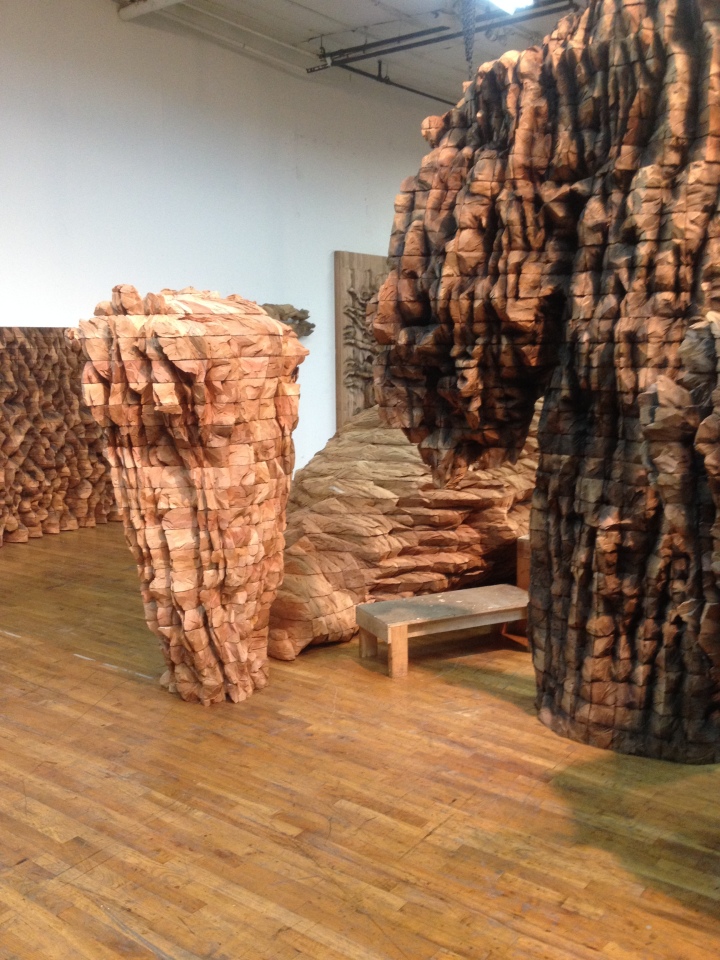
Ursula von Rydingsvard’s studio
Later on in the afternoon, I went on an ISCP field trip to Ursula von Rydingsvard’s studio in East Williamsburg. Von Rydingsvard is best known for creating ‘large-scale, monumental sculpture from the cedar beams which she painstakingly cuts, assembles, and laminates.’
It was a real treat getting shown around her vast workspace and having the complex ins-and-outs of her process described to us, as well as getting some of the wood-cutting procedures displayed by staff.
Studio cat
Another major highlight of the trip was getting to meet the friendly studio cat, who allowed certain cat-loving ISCP residents to give it lots of pats and attention.
In the evening, ISCP executive director Susan Hapgood took us around a few East Williamsburg galleries, where we received talks by different artists and curators. I particularly enjoyed visiting David & Schweitzer Contemporary, where curator Michael David discussed the show that’s currently on in the space, ‘As Carriers of flesh’, which features the work of different figure-painters whose ‘depictions of figures operate on personal, sociocultural and broadly political levels all at once’ (www.davidandschweitzer.com).
David and Schweitzer contemporary
We rounded off the night by attending a pot-luck party thrown by ISCP resident Tove Storch, whose residency is drawing to an end, and we all enjoyed some delicious food cooked by lots of ISCP artists. Not being a great cook myself, my meagre contribution was shop-bought brownies and beer, though tasting some of the wonderful food at the pot-luck party has inspired me to take up cooking at some point.
Now I’m cosy back in the studio, sheltering from the elements and the first of the NY snow!
Post written by Claire Paterson, recipient of the Steven Campbell New York Scholarship
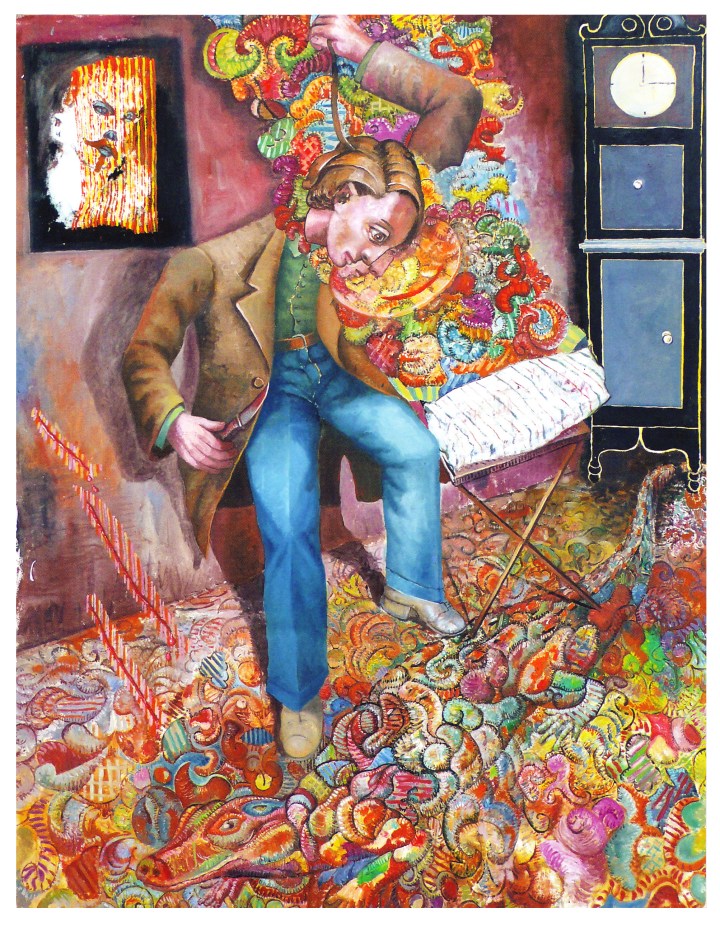
Steven Campbell, The Childhood Bedroom of Captain Hook with Collapsible Bed
While I’m here in New York, I’d like to write about 2 of my favourite Steven Campbell paintings – one of which inspired some poses in my most recent collaborative photo-sessions with models.
The Childhood Bedroom of Captain Hook with Collapsible Bed (above) features a figure that resembles Steven Campbell himself as a younger man, standing in a claustrophobic space, with the painted world encroaching in on him from every side.
At the bottom of the canvas you can see another inclusion from the story of Peter Pan: the crocodile that swallowed Captain Hook’s hand and tormented him, throughout the rest of the tale, with a ticking sound from a clock that it had also swallowed – this ticking perhaps acting as a symbolic reminder of Hook’s own mortality. There’s also a grandfather clock in the background of the work, again drawing attention to the passage of time, despite the fact that everything in the painted scene is fixed and static.
In the top left hand corner, there’s what might be a portrait of the artist as he was when he was working on this piece, staring in at his younger self. Here, time is segmented: past and present coexisting in the painted world. We’re perhaps encouraged to think of what Captain Hook may have been in his youth and innocence, before he became a villain plagued by the idea of mortality.
Next to the artist-character’s face is an object that could be interpreted as either a palette or a mirror, and which reflects the artist’s face whilst simultaneously decapitating him. Paint from its surface spills into the canvas all around, forming a pattern of abstracted space. We begin to wonder whether the figure himself has also spilled out of the palette, as he’s of course no more real than the patterned alligator at his feet.
The figure of the young artist is brandishing a knife, and seems to be attempting to slice through the illusions around him. He’s cut into the palette and the canvas world he’s inhabiting, but has uncovered only more illusion – painted blood that’s just as artificial as the painted walls he’s trying to escape. It appears that the figure is attempting to hang himself with his own hair, but looking closer we become aware of an odd detail: the arm that’s holding him aloft isn’t his own arm, as the hand is the wrong way round. This makes us think that the arm could in fact be a representation of Campbell’s own right arm as he paints the picture and this representation of his younger self.
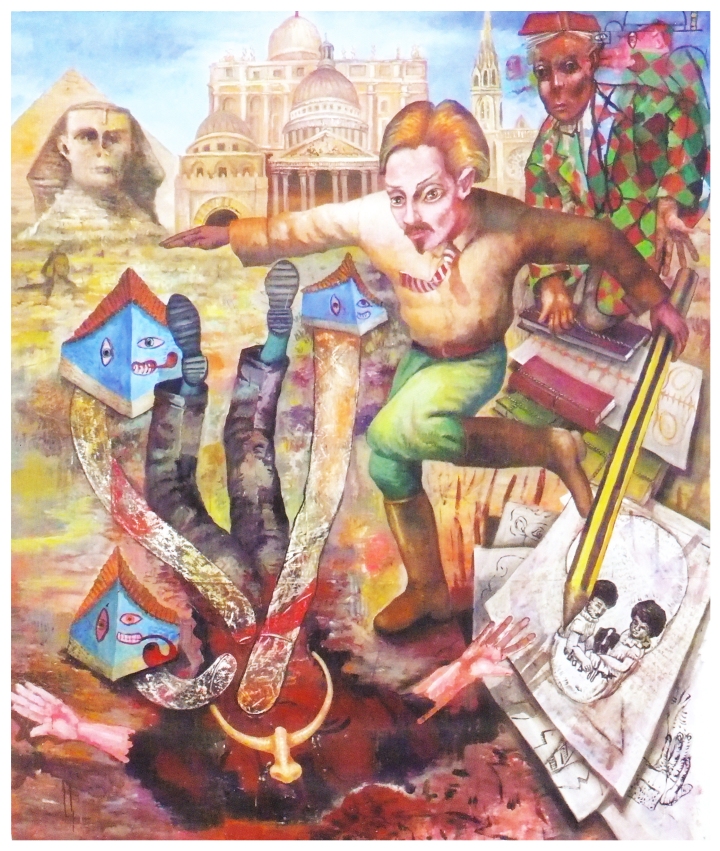
Steven Campbell, Portrait of the Lost Travelogue Writer
Portrait of the Lost Travelogue Writer (above), depicts a figure that also resembles Campbell.
In this piece, the artist’s identity has shifted yet again to become the character of the Lost Travelogue Writer, who’s lost his way in the pictorial world and is trying to make sense of his situation by sketching in his notebooks. As the writer Neil Mulholland points out, ‘the main protagonist looks every inch the maverick archaeologist in search of ancient civilization.’
The location the Travelogue Writer inhabits is surreal, and we can see in the background famous landmarks and works of architecture from all over the world, including St. Paul’s Cathedral, the Vatican, the Pyramids, the Sphinx and Notre Dame Cathedral.
Through this doppelgänger-like character, Campbell’s immersing himself in a quest, where he searches through the great landmarks of civilisation, art and culture, trying to uncover truth. The character brandishes an enormous pencil, and on first glance he appears to be sketching a picture of two little girls playing with a puppy. When you look again, however, you discover that the sketched image is an optical illusion that forms the image of a skull, and this makes us aware, yet again, that nothing’s what it seems in this painted world.
The Travelogue Writer appears to have stumbled across the scene of an accident or murder, with a figure lying sprawled in a pool of what could be either blood or paint. Above, strange Picasso-esque blue figures hover, and we don’t know whether they’re tending to the man, or have participated in his murder. Picasso as an artist was interested in exploring new ways in which to paint and perceive the human form, and the Travelogue Writer has stumbled across this scene where creatures from a certain era of painting are perhaps complicit in some sort of crime or ritual.
Pose improvised in collaboration with model Celeste Dudley, with wishbone sculpture contributed by Amber Fleming, and metallic triangle contributed by Robert Picker
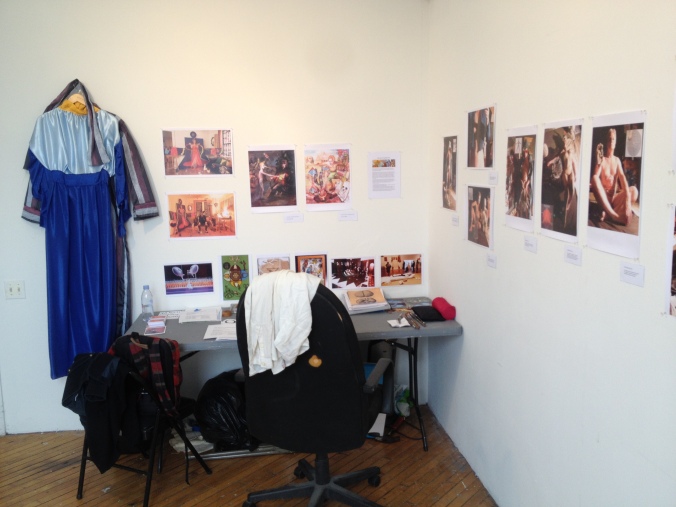
During our collaborative session, NY figure model Celeste Dudley noticed the picture of The Lost Travelogue Writer on my studio wall, and immediately noted correlations between Steven’s painting and some of the props in my studio (the wishbone, the triangle-sculptures etc.), so we decided to recreate the pose of the murder-victim.
The other NY model I’ve been working with – Zeke Jolson – has also written a little bit about the link between some of Steven’s ideas, and the myth-making sessions that have been happening in my studio. I’ll end this section of the post with some of Zeke’s perceptive and thoughtful comments:
‘Claire, I enjoyed reading your insightful posts about the amazing works of Steven Campbell. Perhaps it’s not too much to say that Collaborative Myth-making offers us another or related way to explore the tension between fixed and illusory worlds, where ‘characters are suspended between different places in a sort of limbo or no man’s land.’
‘To what extent can we find a measure of certainty and security in our various environments, or will we be overwhelmed by the chaos or dangers that can threaten us, or even undone by our own fears? Do we feel the need to retreat to a world of make-believe because we don’t want to accept the world as it is, or because something holds us back from doing so? These are just a few of the questions that came to mind after having read your posts and done some further thinking about our Collaborative Myth-making.’
Quote provided by New York figure model Zeke Jolson
Note: A major source for this blog post is the book ‘Steven Campbell: Wretched Stars, Insatiable Heaven’, by Kathy Chambers and Neil Mulholland (available to order on Amazon)
Finally, here are a few highlights from my 6th week in New York (that’s me reached the halfway point of my 12 week residency!):
New York Week 6
Tuesday 6th December
After a day in the studio, I attended a lecture by German artist Kristina Buch, who discussed her work ‘One of the things that baffles me about you is that you remain unmurdered’ – the documentation of which is part of the Animal Mirror exhibition currently on at the ISCP.
I also enjoyed hearing about her work Some at times cast light (2015), where she installed the bronze bust of a fictitious woman in a public site in Bochum, Germany, alongside an official street-sign – the work highlighting how we can be easily manipulated into believing whatever version of history we’re fed, the piece also providing feminist commentary on the lack of celebrated female historical figures and monuments commemorating them.
Wednesday 7th December
Today I had a visit from ISCP’s Sophie Prince, who took some photos of my studio and works in progress. She also gave me some good tips about things to look into in relation to my project, recommending that I visit the NY production of the interactive, site-specific work of theatre ‘Sleep no more‘, in which the public dons masks and wanders through a large house rigged with theatrical lighting, interacting with the actors.
Thursday 8th December
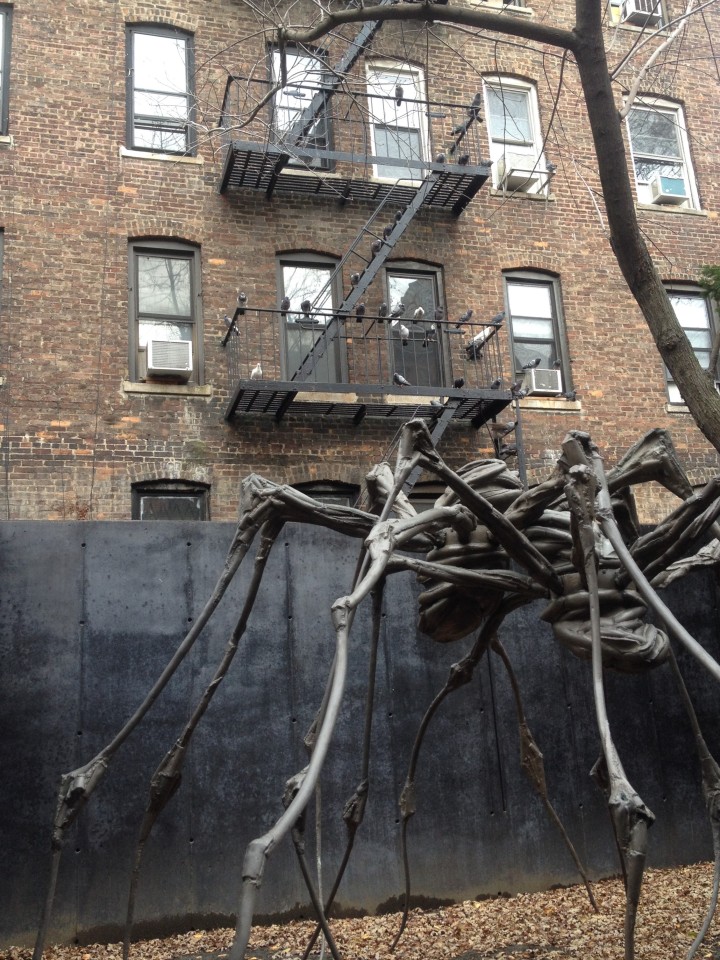
Above: One of Louise Bourgeois’ famous spider sculptures, located in the back garden of her Manhattan residence
This morning I went on a field trip to the Louise Bourgeois house in Manhattan. Ordinarily the house is closed to the public, but the ISCP arranged for a small group of us to gain access.
It was fascinating wandering the narrow corridors and rooms of Bourgeois’ house, seeing the accumulated treasures of an artistic life: nick-nacks and random oddments, an eclectic range of books, sculptures from various stages of her career, phone numbers scrawled in pen on the walls, diaries and bits of paper containing scribblings, through which she attempted to work through artistic and personal problems – all of this juxtaposed with signs of her ordinary everyday life.
A particular highlight of the tour was seeing the window where Bourgeois would sit in her later years when she was elderly and housebound, watching life on the street outside and sketching passers-by.
After this, I went to a Chelsea gallery and had lunch with Laura Fitzgerald, an ISCP resident who’s just arrived from Ireland and is now in the studio next door to me.
Nicholas Roerich Museum
In the afternoon, I went to the Nicholas Roerich Museum on the Upper West Side.
Roerich was a Russian painter, writer, theosophist and mystic – interested in hypnosis and other spiritual practices, and part of a movement of the Russian avant-garde who did ‘experiments on the spiritual dimension of art.’
My friend Elizabeth Kay (who’s been collaborating with me on my project), put me on to Roerich’s work, knowing that I’d be interested in some of the philosophical issues he explores.
I had the Museum entirely to myself, and was able to to wander the 3 floors alone, viewing the strange, otherworldly works in complete silence.
Flicking through some of the books on display in the museum, I also found out that Roerich was a set designer obsessed with theatricality. I was very interested to read this quote, particularly in relation to my own project:
‘To gain deeper insight into Roerich’s paintings, it is useful to apply the notion of ‘theatricalization’. Theatricalization may be defined as the act of making theater of something, of dramatizing or focusing the spotlights, as it were, on various aspects of human existence to illustrate their significance. As it emerges in such ‘theatricalised’ works, the meaning of the images themselves appeal to us and resonate as something common to all of us…’
(Visions from the other side: Works by Nicholas Roerich / Joe Troncale)
After the Roerich museum, I went to an opening of work by ISCP resident Mikkel Carl, who was exhibiting in the apartment of gallery owner Ana Cristea.
Mikkel Carl’s exhibition ‘Now Moving Towards the Inner Circles of Reality’
The entire apartment had become part of the work: from red lights installed in the bathroom to fake security cameras mounted in the living room and bedroom, giving the illusion of surveillance.
After the opening, I went for a couple of drinks at an Irish pub with ISCP’s 2 Irish residents, Elaine Byrne and Laura Fitzgerald.
Friday 9th December
Today I had a meeting in my studio with curator and writer Sara Raza, who is currently curating the third phase of the Guggenheim UBS MAP Global Art Initiative.
We chatted for a full hour, and she gave me a lot of advice on the way she thinks my work should be presented in a show. As well as exhibiting the paintings, she said it’s important to make people aware of the process behind them – and like the critic Adam Kleinman, thought I should possibly do a publication in conjunction with a show: a book that contains letters to artists and models, conversations I’ve had, info on collaborating artists, photographs from the modelling sessions, images of diagrams, and descriptions of the whole ritualistic process from beginning to end.
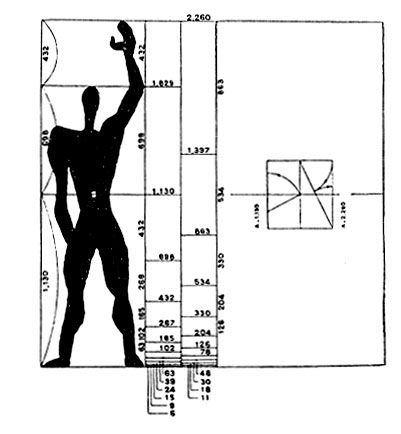
Le Corbusier’s diagram for ‘The Modular’
Sara also gave me an extensive list of artists and theorists she thought I’d be interested in, including the Australian anthropologist Michael Taussig, who writes about Shamanism and Colonialism; the sculptor and essayist Jimmie Durham; Turner prize winner Goshka Macuga, who makes installations which incorporate other artists’ work alongside a variety of disparate objects. Sara also thought I should look into the ‘anthropometric scale of proportions’ devised by the French architect Le Corbusier (above).
Saturday 10th December
This afternoon I took a short break from the studio, and went to an opening in a gallery called The Safe, right next door the the ISCP, which was showing an eclectic range of female artists in a show called ‘Women artist’s for women’s rights.’
Opening and fundraiser at The Safe Gallery, East Williamsburg
Now I’m settling into a couple of days of painting in the studio, enjoying the peace and quiet!
Post written by Claire Paterson, recipient of the Steven Campbell New York scholarship
Work in progress, on an easel that was kindly given to me by ISCP resident John Aslanidis
I’ve been spending a lot of time painting in the studio recently, and I’ve also been corresponding back-and-forth with figure model Zeke. He’s come up with a list of free-associated words that will possibly be used either to title the final pieces, or as a starting point from which meaning can form within the work.
Here are other events / highlights from this last week or so:
Monday 28th November
Thomas Tronel-Gauthier presenting work in his studio
This evening, I went to an event at the ISCP called ‘One artist, one work’, where one resident discusses their practice in their studio space. This time it was hosted by the artist Thomas Tronel-Gauthier from France, who talked about a new body of work entitled ‘Water & Words’.
It was interesting hearing about the process behind Tom’s recent work, which involves him using Chinese ink to print words on paper, before pouring water over the piece to spread the ink and dilute/ obscure the words so that the meaning is clouded or lost.
Terike Haapoja discussing her work and interest in Nonhuman rights
After this, I attended a lecture in the ISCP held by Steven Wise, a prominent animal rights scholar and founder of the Nonhuman Rights Project, and artist Terike Haapoja, who’s currently showing in the Animal Mirror exhibition at the ISCP.
Animal Mirror exhibit, currently on at the ISCP
There were some fascinating topics under discussion, such as whether animals (hopefully starting with chimpanzees) should be granted legal rights and personhood. It was really engaging hearing lawyer Steven Wise discuss the practical ways non-human rights might finally be implemented under current law systems.
Friday 2nd December
Today I had a meeting in my studio with Adam Kleinman – writer, editor, curator, lecturer, sometime performer, and former dOCUMENTA Agent for Public Programming.
We discussed my new paintings, and Adam put forward some suggestions as to how I might develop my current myth-making project . Due to the elements of spontaneity and chance in my work (along with its ritualistic underpinnings, and elements inspired by archaic symbolism & the occult), Adam suggested that I take pieces that I produce collaboratively with models to a tarot reader, and have the fortune-teller do readings of the painted-images themselves – with the random card layouts and symbolic results from this experiment either directly or indirectly incorporated into the title and perceived meaning of the work.
He also thought that the myth-making process and resultant images might work well in a book or publication, and encouraged me to look into this avenue of development as well. He offered some advice on what shows and museums to go to, recommending I visit the Rubin Museum at some point – a NY gallery that focuses on Tibetan art and symbolism.
Later on, as I was thinking about Adam’s Tarot reading suggestion, I remembered that I have a copy of the I-Ching (or Book of Changes) back home in Scotland, and that I could possibly construct random and spontaneous meaning using the I-Ching divination technique of throwing coins.
Just as I was mulling this over, I received an email from New Mexico artist Elizabeth Kay. Liz has also been looking at the results of my recent photo sessions, and along with many other great suggestions and observations, has started to speculate about the idea of NYC itself somehow making its presence known in the new work:
‘Claire, I woke up thinking this morning about the spirit of place in your works. The Scottish works are so imbued with a dark, mysterious, somewhat dangerous, twilight atmosphere, as if the old Celtic spirits were swirling about. I think, too, that the fabrics and objects you and your models chose in those works recall the 19th century or earlier. How will the character of NYC itself be part of the new compositions?’
Quote provided by artist Elizabeth Kay, New Mexico
Liz then went on to talk about how this led her to consider Carl Jung’s forward to the I-Ching, in which Jung talks about consulting the I-Ching as if it were a sentient being. She suggested that I do a similar thing with NYC, ‘inviting it into the mix as if it were a person.’
As well as being intrigued by Liz’s ideas, I enjoyed the fact that we’d both followed completely different trains of thought in relation to my work and arrived, bizarrely, at the I-Ching at exactly the same time, without ever having discussed it before!
***
Interference at NURTUREart
In the evening, I went to an exhibition opening near the studio: Interference at NURTUREart, a group show where the work focuses on the intersection between art & science – the participating artists all sharing an interest in visually representing and interpreting sound-waves, electromagnetism and interference patterns.
Saturday 3rd December
Today G & I went to an exhibition at The New School called Push Play, that the critic Alaina Claire Feldman suggested I visit. She’d told me to look specifically at a collaborative piece by the artists Allan McCollum and Matt Mullican – who’ve created their own divination game ‘Your Fate,’ where the roll of multiple dice, and subsequent interpretation of the symbols, help ‘rework one’s worldview.’ (For more info on the ‘Your Fate’ game, see www.allanmccullum.net).
The symbols on the dice come from Mullican’s ‘cosmology of pictograms’ that are the basis of his work, as well as his interest in divination systems.
G playing McCollum & Mullican’s ‘Your Fate’ Game
While at the show, I decided to combine the ideas of the last two critics I’ve spoken to. Holding the image of a painting I’m working on in my mind, I allowed the random roll of Mullican’s dice determine possible interpretations and meanings for the new piece. I’ll discuss in another post whether these ideas actually come to fruition or not!
G and I then had fun interacting with some of the other game-inspired artworks around the exhibition.
In the afternoon, we headed back to G’s apartment so I could see the new work she’s been making for the last week: soft-sculpture dogs made out of fabric, most of them produced in pairs to keep each other company! We then made the most of the good weather and walked G’s real dog, Blue, through Prospect Park.
The week ended in a pretty weird way. There have been movie trailers parked outside G’s apartment for the last little while: the building and surrounding streets being used as a location in a film. I left G’s apartment, and as I was walking down the stairs into the subway, I realised that I was surrounded by Paparazzi, who were crammed into the underground stop, frantically taking pictures. I squeezed past them to wait for my train, and saw that there was a very glamorous woman in a white fur coat sitting inside a subway car, circled by film crew. I asked a photographer who she was (I’m not great at recognising Hollywood stars!), and was told that it was Sandra Bullock.
Just before I got on my own train, a huge fight broke out between two of the Paparazzi, who had a screaming match on the subway stairs, the whole thing almost coming to blows. When I got home, I phoned G to tell her about it, only to find out that Sandra Bullock is her favourite actress – so she’s going to be a lot more interested in the film crews surrounding her apartment from now on!
So there you go – I’ve seen my first NY movie star this week, and witnessed my first Paparazzi brawl…
Post written by Claire Paterson, recipient of the Steven Campbell New York Scholarship
Pose improvised in collaboration with model Celeste Dudley, with metallic triangle contributed by Robert Picker
Here’s a taster of what I’ve been getting up to in New York. These are just a few of the images produced collaboratively with New York models and artists.
Pose improvised in collaboration with model Zeke Jolson, with paper mache dog contributed by G.Paterson
Model Zeke has written a short statement about his perspective on his myth-making session and the resultant images:
‘Even a brief, first glance at the photos fills me with a sense of wonder. The interaction of elements seems quite magical: the form and movement of the body; the variety of objects raised, held and touched; the mystery of costume and disguise contrasting with openness and nakedness; the role of chance, play and spontaneity – all of this has a worldly and other-worldly quality.
‘I was also struck by how the abundant interplay of light and shadow in the photos heightens the dramatic impact and allows room for many different interpretations by viewers. The light really draws the eye in and fires the imagination.’
Zeke Jolson, New York figure model
Many of Zeke’s own interests and aesthetic sensibilities emerged over the course of our session, and I feel that in some of the poses, his grace from his time as a figure-skater is apparent.
Pose improvised in collaboration with model Zeke Jolson
Figure model Celeste – an actress specialising in Shakespeare – has also provided some insight into interests that inspired many of the poses she adopted in her session:
‘I’m a huge mythology fan from many cultures, though the ones I know the most about are Grecian, Celtic, Native American, Egyptian, and Norse. I am intrigued and attracted to the elements of that I see in your work – the feathers, the labyrinth, the Athena pose, the Vitruvian Man, the Celtic knots – it all looks wonderful! I love the idea of collaborative myth-making.
‘The Steven Campbell Poised Murder scene inspires me as well. I hypothesize that creating a ‘murder scene’ would invite a different layer of understanding for me. I have always wanted to play a dead body on Law & Order, but have still never had the chance! So your influences in that respect draws me.’
Celeste Dudley, New York figure model
Pose improvised in collaboration with model Celeste Dudley, with paper mache dog, mandolin & self-portrait head contributed by G.Paterson, and metallic triangles & handmade arrow contributed by Robert Picker
During our myth-making session, Celeste and I were not only inspired by Poised Murder, but by a few of Steven Campbell’s paintings too, including Portrait of the Lost Travelogue Writer.
As you can see below, the wishbone (contributed by Amber Fleming), the triangle (contributed by Robert Picker), the tweed-like trousers, and even the skull diagram selected by Celeste to be incorporated into some of her compositions, mirror many elements from Portrait of the Lost Travelogue Writer.
Pose improvised in collaboration with model Celeste Dudley, with wishbone sculpture contributed by Amber Fleming, and metallic triangle contributed by Robert Picker
Steven Campbell, Portrait of the Lost Travelogue Writer
Next week, I’ll be writing more about Portrait of a Lost Travelogue Writer, along with one of Steven Campbell’s other paintings from the same period, The Childhood Bedroom of Captain Hook.
Post written by Claire Paterson, winner of the Steven Campbell New York Scholarship
Monday 21st November
A mixer event was held at the studio today – residents & staff from Socrates Sculpture Park in Queens dropping by to visit us at the ISCP. A great spread of Greek food was put on courtesy of the ISCP, and we all went home very well fed!
Socrates Sculpture Park in Queens
Socrates Sculpture Park is an outdoor museum and public park, where artists can ‘create and exhibit sculptures and multimedia installations’. After chatting to residents at the mixer, I’m keen to visit the park, as it sounds like there’s some interesting stuff happening there, even with winter approaching.
Over the last couple of months, Socrates staff member Chris has been constructing a studio from stacked shipping containers in the park, and has invited people from the ISCP to come along and see how the project’s progressing.
Tuesday 22nd November
Stupidly chose the windiest day of my trip so far to carry canvases from the art store, almost getting blown away a few times in the process. Made it back to the studio in one piece though, and managed to get some undercoats painted. One of the ISCP’s other residents, John, has kindly given me a lot of his paint, as he’ll be going home to Australia soon – so I’ve got plenty to get me started.
Wednesday 23rd November
This evening I followed advice my flatmates Ash & Giles gave me, and headed out to the Museum of Natural History to see the bizarre Macy’s Parade Balloon Inflation, where all of the vast balloons of cartoon characters that are used on the Macy’s Thanksgiving floats are filled with helium over the course of around 7 hours.
I arrived towards the end of the event, when the balloons were almost full, and saw Ronald McDonald, Charlie Brown, Paddington, Pokemon and lots of other famous characters looking like surreal, bound beasts, trapped under nets and hooked up to helium machines. There was something vaguely sinister about the whole thing, particularly with the addition of the relentlessly cheery festive music blaring over the outdoor PA system.
Thursday 24th November – Thanksgiving
G came along to the studio in the late afternoon to offer me some advice on my blocked-in compositions, and we started Thanksgiving festivities early with some wine there.
Afterwards, we went up the road to my apartment, where Ash and Giles cooked a delicious Thanksgiving meal with a homemade pumpkin pie for dessert.
Friday 25th November
Leftover pumpkin pie for breakfast, to fuel me through another studio day! Later my friend Sarah popped round to the flat, and we had a fun evening listening to music from Ash and Giles’ huge record collection.
Saturday 26th November
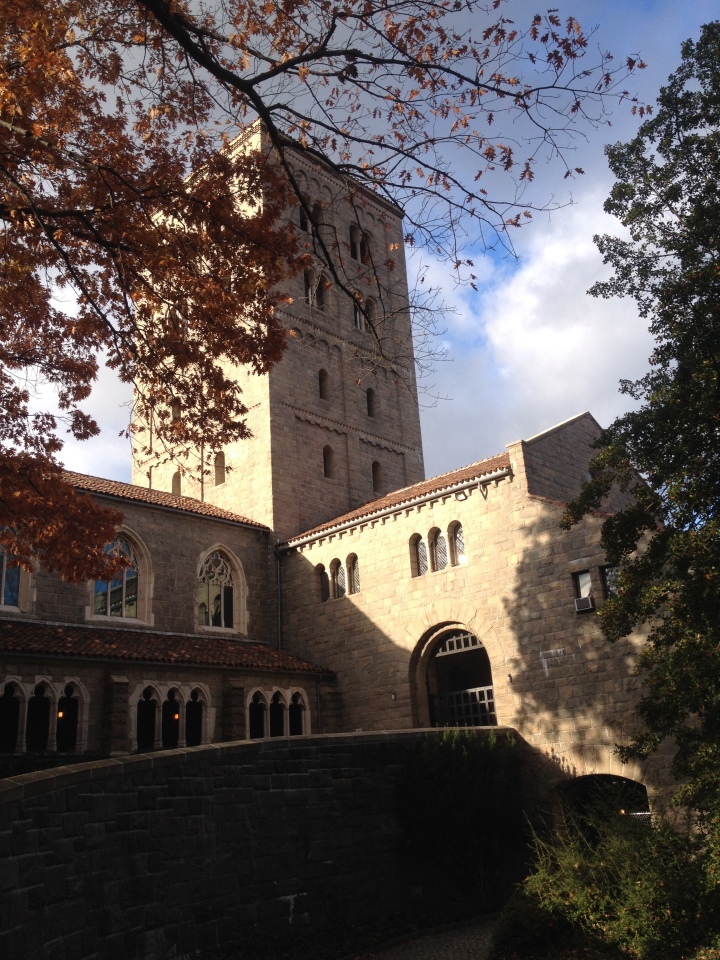
Today G and I went to The Cloisters in uptown Manhattan, walking through Fort Tryon park and taking in views over the Hudson river, the water framed by Autumn foliage.
The Cloisters
After having brunch at a restaurant in the park called New Leaf, we wandered through The Cloisters, admiring the courtyards, chapels, ramparts, stained-glass windows, and various architectural features intended to ‘invoke in visitors a sense of the Medieval European Monastic life,’ containing something of the light and atmosphere that I’ve tried to create recently in my myth-making sessions with models.
As G and I both explore similar subject matter in our work, we were in our element viewing the original Medieval reliquaries, statues and tapestries – many of which showed recognisable religious tableaux, whilst others had something altogether stranger going on: a bizarre mishmash of Pagan and Christian symbolism leading to some pretty unusual scenes. This was particularly evident in the surreal & bloody drama unfolding in the Flemish Unicorn Tapestries, where the suffering of a hunted Unicorn is intended to mirror the suffering of Christ.
The Unicorn Tapestries
Sunday 27th November
Ended the week in the studio, getting stuck into painting. In a few days, I’ll be doing my first post about my new work, as well as writing about some of my favourite Steven Campbell paintings – one of which inspired a particular pose produced collaboratively with figure model Celeste.
Post written by Claire Paterson, winner of the Steven Campbell New York Scholarship
Monday 14th November
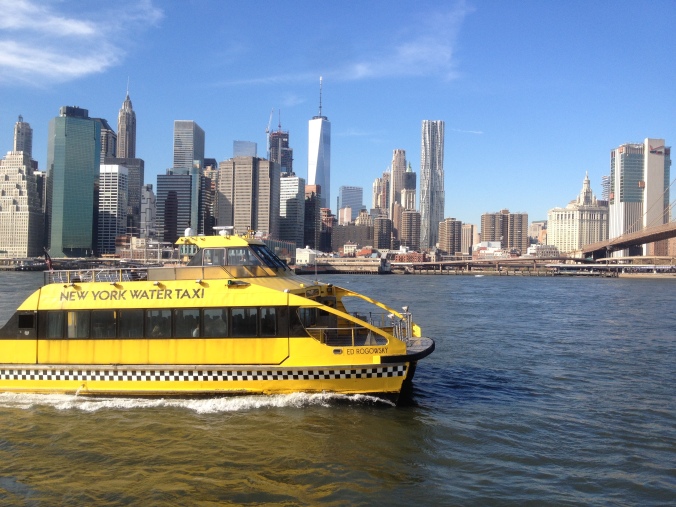
Rode the East River Ferry from Brooklyn to the Dumbo area this morning, enjoying the bracing cold wind combined with hot sun (travelling this way definitely beats taking the underground). After disembarking, I wandered along the riverside, taking in the views of the Manhattan skyline across the water.
I met G and my room-mate Ash for lunch at a place called The Archway, near where they both work for the artist Jenny Holzer. Later I had a meeting with David Terry at the New York Foundation for the Arts, to discuss the possibility of me giving a talk there in January.
Above: The New York Foundation for the Arts
Tuesday 15th November
Quiet day in the studio today, followed by attending a talk by a couple of ISCP’s resident artists in the evening.
Curator Rael Artel spoke about the group exhibition If This is The Museum We Wanted, that addressed her position as director of the Tartu Art Museum in Estonia. Her curatorial work relates to topical issues in contemporary society, such as transformation and identity politics – and I particularly enjoyed her talking about the decision-making process for artists and curators.
Above: Rael showing the art museum where she works in Estonia – discussing how bizarre it is to work in a leaning building.
Thomas Taube then spoke about his artistic practice alongside the power of images. He finished by opening up the floor to a discussion on American politics, which I think was very therapeutic to a lot of the residents, who were able to vent some feelings about the events of the last week or so!
Wednesday 16th November
A full day in the studio today (images to come soon), with a little break in the middle of the afternoon to meet my friend Sarah for lunch.
As mentioned in a previous blog post, Sarah is one of my friends from the Glasgow School of Art, who happens to be in New York at the moment studying film.
During lunch at a great noodle place in Greenpoint, we made the truly bizarre discovery that for the last couple of nights, we’ve actually been living right beside each other on the same street without realising. It turns out that Sarah’s brother who she stays with sometimes is my next door neighbour. Considering NY has 8 million residents – almost twice the population of Scotland – this is a pretty major coincidence, so I thought it merited a mention in the blog!
Thursday 17th November
Great field trip today organised by the ISCP. Started out in the New Museum, where we saw the exhibition Pixel Forest by Pipilotti Rist that spanned three levels of the building. It was an atmospheric show – a sensory, interactive experience in which you’re free to touch hanging constellations of lights and dangling material, stick your head inside triangular sculptures to watch hypnotic videos (reminding me a bit of Alex’s brainwashing session in A Clockwork Orange), and lie back on beds to view projections on the ceiling – all against an audio-backdrop of meditative, ambient music.
This was followed by a walk through South Manhattan to The Drawing Centre, where there were exhibits on by Cecily Brown and Olga Chernysheva. The Drawing Centre itself is a very interesting contemporary space that focuses mainly on the exhibition of drawings, whilst also displaying artists working in other media who use drawing as an inspiration or basis.
After this, a group of us went to a little local Italian restaurant, where we dined on authentic Italian food – very enjoyable after a day going around galleries.
In the evening, I took the underground out to Chelsea, to attend the opening of an exhibition by the painter Jon Schueler. Magda Salvesen, Jon Schueler’s wife and the manager of his estate, had kindly come to visit me during my open studio event 2 weeks ago, and invited me along.
Schueler’s perhaps best known for his abstract skyscapes that he initially started painting in the fishing village of Mallaig in Scotland. The exhibition Women in the Sky, however, concentrates on his figurative work, which is grouped together at the Berry Campbell Gallery for the first time. The works on display, painted from life, contain a massive amount of gestural energy, making me want to return to the life room at some point. On the subway back from the opening, I coincidently met another artist from Greenpoint who’d also been to the opening, and we were able to discuss the show on the way home.
Friday 18th November
Quiet studio day today – I’ll be posting about my new work very soon!
Saturday 19th November
This morning G and I went to the Hauser & Wirth Gallery on 18th street to see an exhibit by Paul McCarthy, enjoying the monolithic sculptures of the Seven Dwarves from Snow White, warped, distorted, distended, deformed and mutilated to become sad and monstrous in equal measure.
We then went around the corner to Hauser & Wirth’s other location to see Philip Guston’s Laughter in the Dark exhibit: a series of satirical political cartoons featuring President Nixon. Couldn’t help but wish Guston was still around to make satires of current political figures!
Afterwards, we headed to the Chelsea Flea market so I could seek out more objects for use in future collaborative sessions. Genevieve and I were also able to do some Xmas shopping for each other, though it was hard to keep our purchases secret from one another.
This afternoon, I went into the studio to meet Alaina Claire Feldman, a curator and Director of Exhibitions at Independent Curators International (ICI). She had some great insights into my project, along with some tips about what exhibitions I might find interesting in relation to themes I’m currently exploring.
Alaina suggested that though the models I’ve been collaborating with do have a degree of authorship when it comes to choosing props and determining poses, this process could perhaps be extended to the titling process in my work. With my recent pieces, I’ve been titling compositions through a sort of free-association, seeing if the images call any phrases or words to mind and working from there. Alaina thought it might be interesting to send the chosen images to the models I’ve been working with and have them free-associate some phrases instead, so that they are part of the process of creating the artwork from its inception all the way through to the final title. With this in mind, I’ll be sending images on to models Z and C next week to see if they have any ideas.
Alaina also thought that there was a link between my work and games, due to the elements of chance, interaction, and spontaneity involved in my collaborative sessions. She recommended that I visit a show at The New School called Push Play, that explores the work of artists who borrow from play and games to expose social, cultural and philosophical issues. She thought I’d be particularly interested in the show because of its participatory element, encouraging the public to take part and interact with the gaming elements displayed in the space.
We also talked for a while about elements of symbolism, chance, fate and an interest in the occult & mysticism that’s beginning to emerge in my work, with Alaina also suggesting that I look at Allan McCollum & Matt Mullican’s divining game when I visit Push Play.
Sunday 20th November
Another quiet studio day, making a final selection of images from my photo sessions, ready to send to models Z and C next week.
Post written by Claire Paterson, winner of the Steven Campbell New York Scholarship
Mark Leckey exhibit at MoMA PS1 in Queens
Monday November 7th
Went into the ISCP this morning and got settled into my space, starting to create an environment for the photo sessions, which begin Wednesday.
In the afternoon I travelled out to MoMA PS1 in Queens. My flat mate Giles works there, and has spent the last couple of months setting up the Mark Leckey show that occupies most of the floors of the building. I was bowled over by the amount of hard work that has clearly gone into assembling such a vast and complex show.
Mark Leckey exhibit – ‘The Universal Addressability of Dumb Things’
I’m interested in some of the ideas that Mark Leckey explores. Leckey has an obsession with primeval myth and the initiation of transformations, and the part of the exhibition that I was drawn to most was a dark gallery filled with black-light images and eerily illuminated objects. Leckey wanted to imbue these stationary objects with ‘animist energy’ and create a ‘composit of random meaning’ like a surrealist exquisite corpse – something I’ve been exploring recently in my own work.
James Turrell’s ‘Skyspace’ at MoMA PS1
At dusk, I was fortunate enough to stumble across the ‘Skyspace’ on the 3rd floor: a site-specific installation by James Turrell in which he’s removed a slice of the gallery roof, leaving the space open to the elements. I was able to sit and watch the sky change colour above, with its edges rimmed by ethereal artificial light from inside the gallery.
Tuesday November 8th
Today I went searching around thrift stores in Brooklyn, looking for objects and props to use in my collaborative sessions with models.
Housing Works thrift store
Later on, I joined other students at the ISCP to watch the US election.
Wednesday November 9th
This morning I met up with New York figure model Celeste – a very talented Shakespearean actress, who also does aerial performances and puppet shows, amongst other things. The photo session and collaboration was great fun, with a lot of improvisation and an inspiring back-and-forth exchange of ideas (images to come soon!)
Thursday November 10th
The Big Reuse resident cat
This morning I went out to The Big Reuse in Brooklyn to seek out more objects and props for possible use in my next collaborative sessions. One of the main highlights of my trip was petting The Big Reuse resident cat, who lives in the warehouse, sleeps on top of stacks of books, and enjoys cuddles from the staff!
In the evening, Executive Director at ISCP – Susan Hapgood – was good enough to host a gathering for ISCP residents at her home, before taking us around various openings that were happening in Chelsea, including a Paul McCarthy show that I’m planning to return to during the day at some point for a proper look around.
Andreas Gursky opening, Gargosian Gallery
Friday November 11th
This morning I met with figure model Z, having tea at Lula Bean cafe in East Williamsburg and discussing our collaboration, before heading to the studio for our photo session. Z brought along a mask and costume elements he wanted to use in his myth-making session – and because he’s a figure-skater, he was interested in creating particularly graceful poses.
John Aslanidis, Sonic Series opening night at the Australian embassy in Manhattan
In the evening, I went to the Australian embassy in Manhattan, where John Aslanidis – an ISCP artist from Sydney – was having an exhibition. It was interesting seeing many of John’s paintings gathered together in the one space. When viewed from a distance, the colours of the Sonic series really seem to thrum, the painted circles showing the ripple effect of sound-waves, so that his work seems to exist ‘at the threshold between music and painting’ (www.johnaslanidis.com). Discussions with John last week have led me to want to explore the influence of music on the myth-making process – and during my session with model K on Wednesday, I was able to use some music files John sent to help influence and determine poses.
Saturday November 12th
G and I visited Mr Picker today, one of the artists who’s contributed work to the collaborative myth-making process.
Mr Picker’s metal triangles on my studio wall, used during my collaborative session with figure model K
Loved seeing Mr Picker’s art collection, which included an original Joseph Beuy’s print and a Hans Bellmer piece. I also enjoyed getting the tour of his inspiring Manhattan apartment, which is packed with his own paintings, sculptures and found objects.
Mr Picker showing his book collection. In the background is his work Flora, with the caption: ‘Flora liked springtime best because she comes in colours everywhere.’
In the afternoon, Mr Picker took us around some of his favourite sections of the Met, which is right by his apartment. Was enjoyable to see the links between certain Met pieces, and Mr P’s eclectic interests and the themes that appear in his own work.
Mr P showing us around some of his favourite swords in the MetOne of Mr P’s favourite sculptures – The Demidoff Table, by Lorenzo Bartolini
Sunday November 13th
Quiet day in the studio today, sorting through photos from my modelling sessions with C and Z. Looking forward to next week – already got lots planned!
Post written by Claire Paterson, winner of the Steven Campbell New York Scholarship
DAY 1 – Tuesday November 1st
I arrived in New York, and booked my very first Uber cab to take me out to my apartment in East Williamsburg.
At the apartment I met my room-mates Ash and Giles, both talented artists who went out of their way to make me feel at home. In the evening I had a wander around the neighbourhood, tracking down a good little coffee shop and taking a walk through a local park that’s bursting with Autumn colours right now.
DAY 2- Wednesday November 2nd
In the morning, I headed into the ISCP, where I met with the staff and 4 other artists who are starting their residencies at the same time as me. I collected my keys and checked out my studio, a great space with huge windows and lots of natural light. I’m on the the 3rd floor with 5 other artists, and we have our own little lounge and kitchen area.
In the afternoon, I went out to visit my sister G in South Brooklyn, meeting her dog Blue for the first time and getting to see her wonderful, art-crammed apartment.
G had set aside lots of objects and sculptures for me to use in my collaborative myth-making sessions, including pieces by the artists Amber Fleming and Robert Picker (who I’ll talk about in upcoming blog posts).
We booked a cab and travelled back to the ISCP, probably bemusing the driver with all of the sculptures we managed to cram into the boot and on our laps in the back seat. I then worked well into the evening at the ISCP, getting my studio ready for the Open Studio event.
DAY 3: Thursday November 3rd
ABOVE: Japanese artist Tetsugo Hyakutake’s studio (www.tetsugohyakutake.com)
Today the artists in the ISCP opened their studios to each other, so that we could all get some idea of what everyone else on the residency is getting up to.
I had a particularly interesting conversation with the Australian artist John Aslanidis, whose paintings are influenced by music and sound waves. When I discussed my own project with him, he suggested that I use music as an influence on my collaborative myth-making process – to see if certain pieces, if played while the sessions with models are happening, might influence the poses that are generated. John has agreed to collaborate with me, and has sent me some music samples he thought might be interesting to use in my first modelling sessions next week.
DAY 4 – Friday November 4rth
Today was the public launch of the ISCP’s Open Studio event. My sister G came along, as well as Amber Fleming and Robert Picker, the other artists who’ve contributed sculptural pieces. The opening was very busy, and I was chatting to the public all evening, getting lots of different perspectives on my upcoming project. One of the NY models I’ve been in touch with came all the way out from New Jersey to get an advance look at my studio before our first photo session next week, and it was great exploring ideas with him about what’s going to be involved.
After the doors closed at 9pm, we all headed to an after-party at a pub around the corner called The Arrogant Swine, whose management had arranged an all night Happy Hour for ISCP artists.
DAY 5 – Saturday November 6th
ABOVE: Maartje Korstange’s offsite work, part of the ‘Animal Mirror’ exhibit at the ISCP – www.maartjekorstanje.nl
Walked to a local park this morning to see an offsite work by Maartje Korstange, one of the artists on my program. Maartje talked for a while about her outdoor piece, an ‘organic site-specific sculpture related to the recent disappearance of a large number of North American honeybee colonies, meant as much to serve as a home for solitary bees as for the enjoyment of its human visitors.’
Afterwards, I spoke to Maartje about her work, and after discussing my own project, she has kindly offered to lend me a sculptural piece for my myth-making sessions. We headed back to the ISCP, where I visited her studio and carried one of her beautiful sculptures upstairs to my own space. (I’ll be writing a more in-depth blog post about Maartje Korstange at a later date).
My studio opened to the public from 1pm-8pm, and my space was busy all day. Magda Salvesen, wife of abstract expressionist Jon Schueler, paid me a visit, and has invited me to an opening next week at the Berry Campbell Gallery, where Jon Schueler’s figurative work is getting shown.
I also had a visit from Sarah Ingersol, one of my friends from the Glasgow School of Art who’s in NY at the moment studying film and making documentaries. Overall, it was a great day of meeting people and discussing my project with the public, many of whom gave me some good tips about what to see and do while I’m in New York.
DAY 6 – Sunday November 7th
Enjoyed an extra hour in bed today because of the clock change, then wandered down to Manhattan Avenue to watch a little bit of the New York marathon and soak in the atmosphere. As it was a beautiful day, I went to visit my sister and we took Blue for a long walk in Prospect Park before having a catch up over dinner. It was a relaxing day of recharging my batteries in preparation for what’s already shaping up to be another busy and exciting week next week!
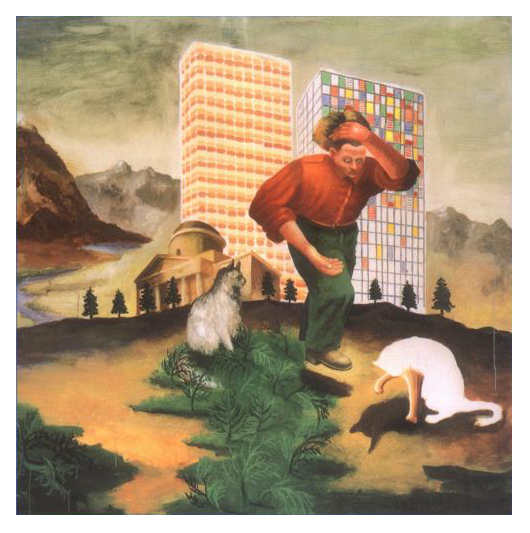
‘I think I became less interested in art, conceptual versus figurative, that kind of thing, and I became more interested in thinking about why things are the way they are’ – Steven Campbell.
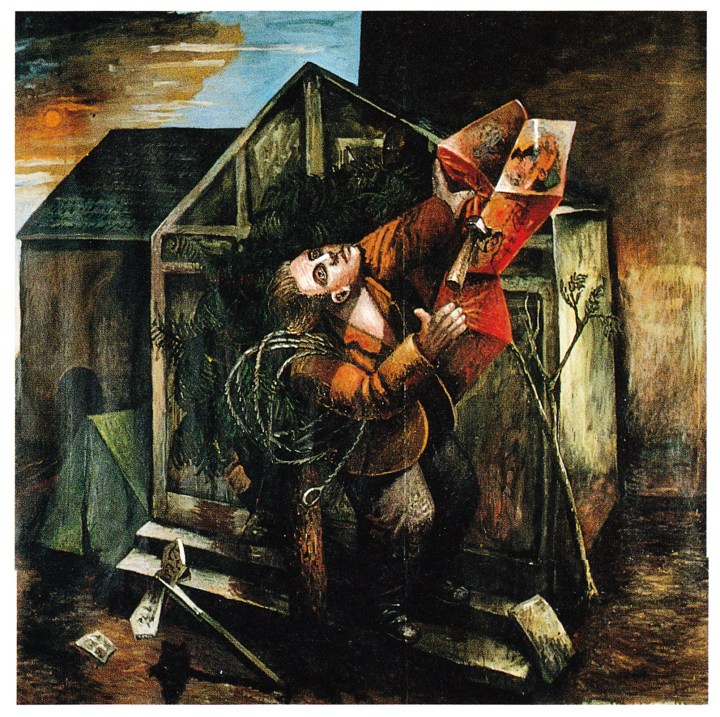
Steven Campbell’s work displays a persistent fascination with illusion and the levels of reality that exist within a painting. By their nature, figurative paintings are flat and static, showing fixed and illusory worlds, the subjects trapped in time, caught in the confines of the canvas. As the writer Duncan MacMillan observes, while Campbell’s characters ‘innocently explore the apparent freedom of the world they inhabit, they run up against its limits, and, unconsciously, burlesque the limitations of the painters art and so of life itself.’
In the above painting, The Man who climbs Maps, we see the character of the Lost Hiker. Like so many of Campbell’s characters, the Hiker has strayed from his path, and in desperation, attempts to climb his map as if it were a cliff face.
Here, Campbell invites the viewer to consider the nature of painted space. In the world of painted narrative, everything is two-dimensional and on the same plane of existence: the flat illustrations on the map essentially no different from the surrounding landscape and the Hiker himself. Confused, the character mistakes the map for the territory and embarks on his absurd expedition.
Another interesting detail in this painting is the signpost on the bottom left. Such signposts appear often in Campbell’s work, indicating that the characters are suspended between different places, in a sort of limbo or no-man’s land. They never reach their goal or destination, and are trapped in an illusory world that frustrates them at every turn.
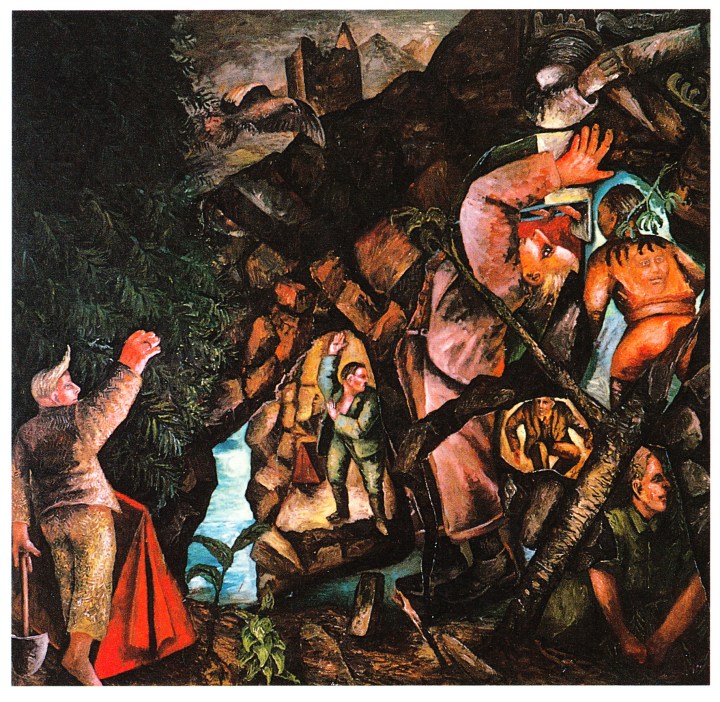
Steven Campbell – Young Camper Discovering a Grotto in the Ground
In Young Camper Discovering a Grotto in the ground, Campbell further explores the illusion of painted space. It has seven figures in different scales, and in this crowded painting, we’re not entirely sure who the camper is, and it may in fact be all of them.
The perspective here seems intentionally confusing: we don’t know whether characters are in the background or foreground, and are finally led to conclude that each figure inhabits his own ‘grotto’ of space in the picture-plane. These grottos overlap in a sort of mosaic, confusing the viewer, and apparently confusing the characters themselves. Campbell has taken images that may have made pictorial sense; dismantled, restructured and overlapped them, to demonstrate that representational painters deal only in illusion.
Steven Campbell – Not you as well, Snowy
Campbell made this a major theme of his work in an exhibition he had at the Third Eye Centre in Glasgow (now the Centre for Contemporary Art) in 1990. The show questioned received notions about reality, often in a humorous way. In many of the paintings, certain figures or objects were missing, showing only white canvas in the place that they had once been or were intended to be.
The above painting Not you as well, Snowy, shows a young man returning home to see that his cat has also undergone this horrible metamorphosis, snatched from reality to leave only a blank silhouette in its place. Something which, to us, is only a bit of blank canvas in the middle of the picture plane, becomes the shape of this poor character’s missing cat – snatched away into the ether, leaving only his shadow and his paws. In this disturbing yet humorous way, Campbell questions the reality of our own world.
Sources used in this blog post: The Paintings of Steven Campbell, by Duncan MacMillan (p.27, 36, 37 & 65). If you’re wanting to find out more about the work of Steven Campbell, I’d highly recommend getting this Duncan MacMillan book, which looks at Campbell’s work in a great deal of depth.
For other posts about Steven Campbell, please visit Claire Paterson’s WordPress page:
 Pose improvised in collaboration with Emma Wylie and G.Paterson, with costume elements contributed by G.Paterson, and sculptural objects contributed by G.Paterson and Maartje Korstanje.
 Pose improvised in collaboration with Emma Wylie, with costume elements contributed by G.Paterson, and metallic triangles contributed by Robert Picker.
 Pose improvised in collaboration with Emma Wylie and G.Paterson, with costume elements contributed by G.Paterson.
 Pose improvised in collaboration with Emma Wylie and G.Paterson, with costume elements contributed by G.Paterson.
 Pose improvised in collaboration with Emma Wylie and G.Paterson, with costume elements contributed by G.Paterson, and sculptural objects contributed by G.Paterson and Maartje Korstanje.





























 The Steven Campbell Trust