April Calendar: Pinocchio

April Calendar: Pinocchio

IMG_1616

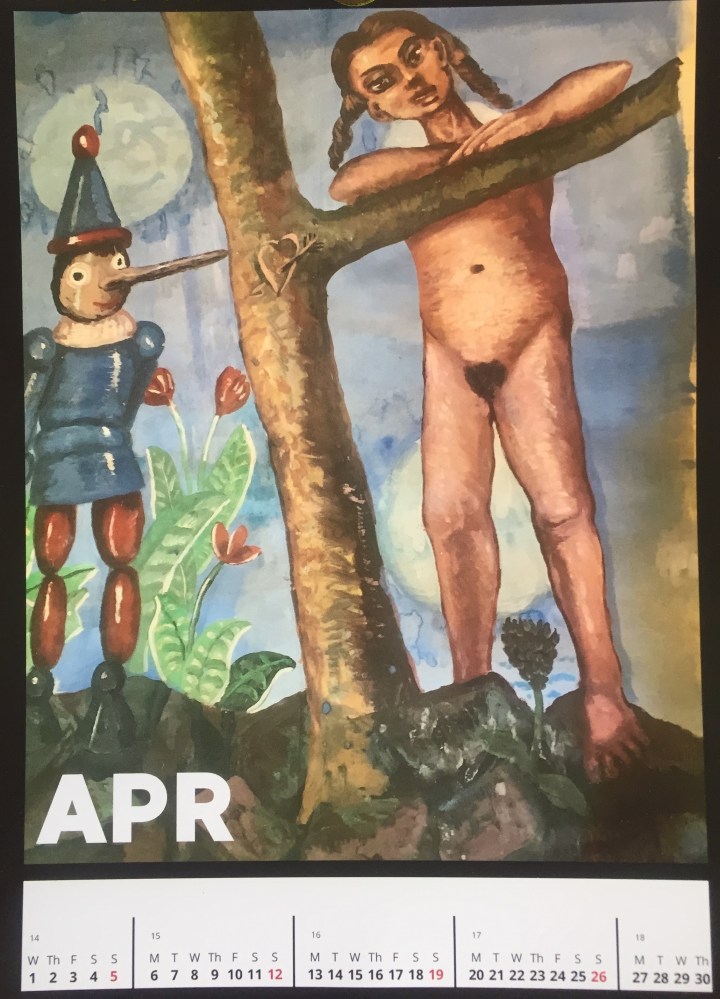
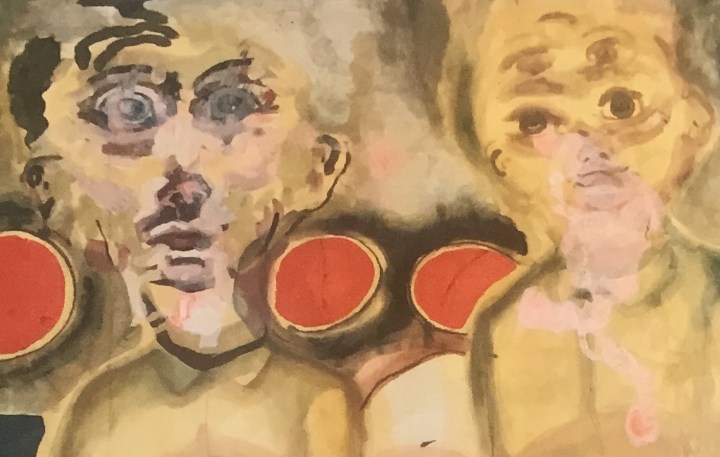
Our Steven Campbell Trust calendar April image, draws on what was to become a leitmotif for Steven for over a decade: Pinocchio.

 
Our family has for many, many years spent our summers in Italy with the majority of our time spent between Tuscany and Umbria around Cortona and Lago Trasimeno.

 
We first started going when our 3 children were small and it was then that we discovered a theme park on the outskirts of Perugia called Citta Della Domenica or Sunday City. I use the term theme park very loosely, as the park was set up in the 60’s and has changed little since then. It is part nature reserve, part sculpture-park but it does indeed have a theme and that theme is Pinocchio, not the Disneyland cartoon character but the much darker original story by Carlo Collodi.

 
Dotted around the park are various scenes from the story, some funny but others quite frightening, especially for young kids.

 
One in particular which struck Steven, was of Pinocchio sitting very dismally in a dark cave-like prison shackled to the wall. He did in fact make a painting of it called Pinocchio in Chains.

 
The Pinocchio here however is modelled on the souvenirs that crowd all the shops in the surrounding area from Lucca to Siena. They come as jointed figures, as in the painting, ranging in size from key rings to actual puppets, some even come as comically collapsible figures when you press the bottom of their stand.

 
Steven has chosen, on this occasion, to combine him with a female protagonist, a loosely based Heidi type figure, a pubescent girl/woman straddling both those worlds while embracing the tree that we could conjecture had been the one used to make our hero.

 
Steven had since the 80’s, with his Painting Ding Dong in the National Gallery of Scotland, drawn upon this female figure complete with her childlike braids, juxtaposed with her womanly strength or self knowledge.

 
Further Pinocchio images and information can be found in articles relating to Steven’s 1993 exhibition at the Talbot Rice Centre in Edinburgh, called Pinocchio’s Present.


Carol Campbell.

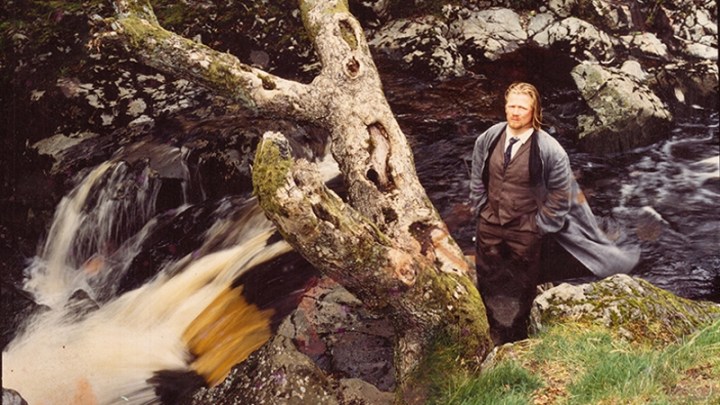
Portrait of the Lost Travelogue Writer

Portrait of the Lost Travelogue Writer

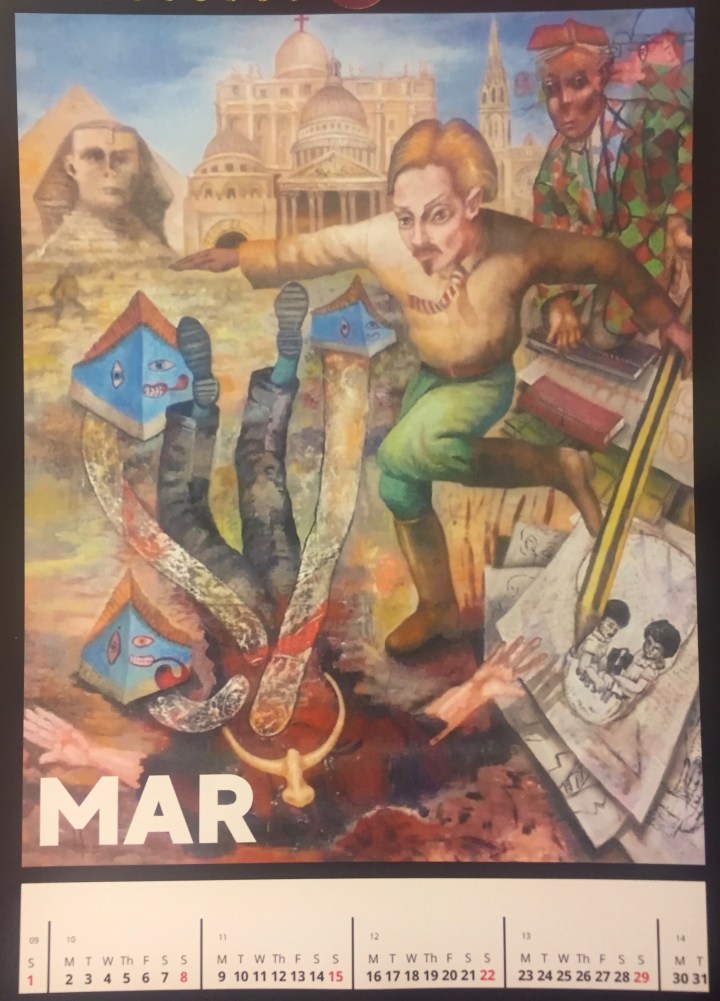
Continuing with our 2020 feature of images from our Steven Campbell Calendar, our March selection is:

Portrait of the Lost Travelogue Writer

IMG_1191

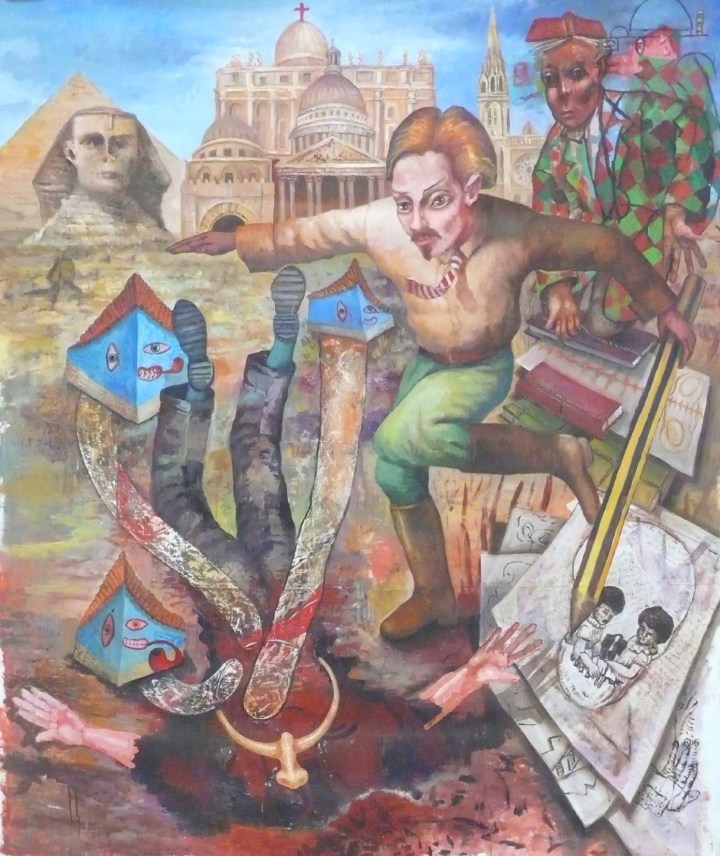
This painting is a personal favourite of mine being as it is dominated by the self-portrait of Steven. Although he never deliberately set out to paint himself it was rather just an innate understanding of his own face, which he would often pass his hand over while painting.

It also has a true poetry (like Man who Climbs Maps) mixed with the ridiculous quality of a Wodehouse, Bertie Wooster scenario.

The background is dominated by 3 recognisable tourist attractions, the Pyramids/Sphinx, the Vatican and Westminster Abbey. The harlequin styled figure to the right was inspired by an old postcard Steven bought in Aix en Provence while visiting Cezanne’s studio at Jas de Bouffan.

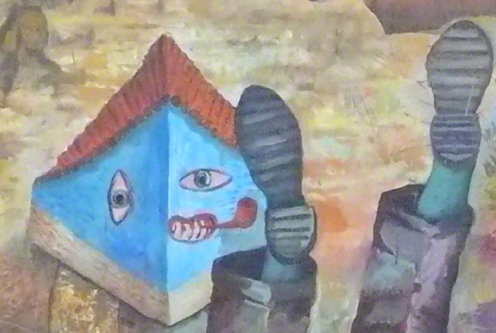
The blue pyramid shapes were inspired by a visit to the Picasso museum in the Marais, Paris and the Las Meninas series. He took the Picasso pyramid shape and turned it around adapting it to his needs while still acknowledging the original.

The falling figure harks back to his drawing of The Fern’s revenge on the Gardener, while the optical illusion skull was inspired again by old French postcards and the work of Danish psychologist Edgar Rubin with his profiled heads forming a white vase, which do you see first?

As in all of Stevens work, we’ve come upon our protagonist midst scene, like a still from a movie where we can guess at what has passed but must make up our own script as to his future.


Carol Campbell


February: Crash Cubism (The Neo-Classical Period).

February: Crash Cubism (The Neo-Classical Period).

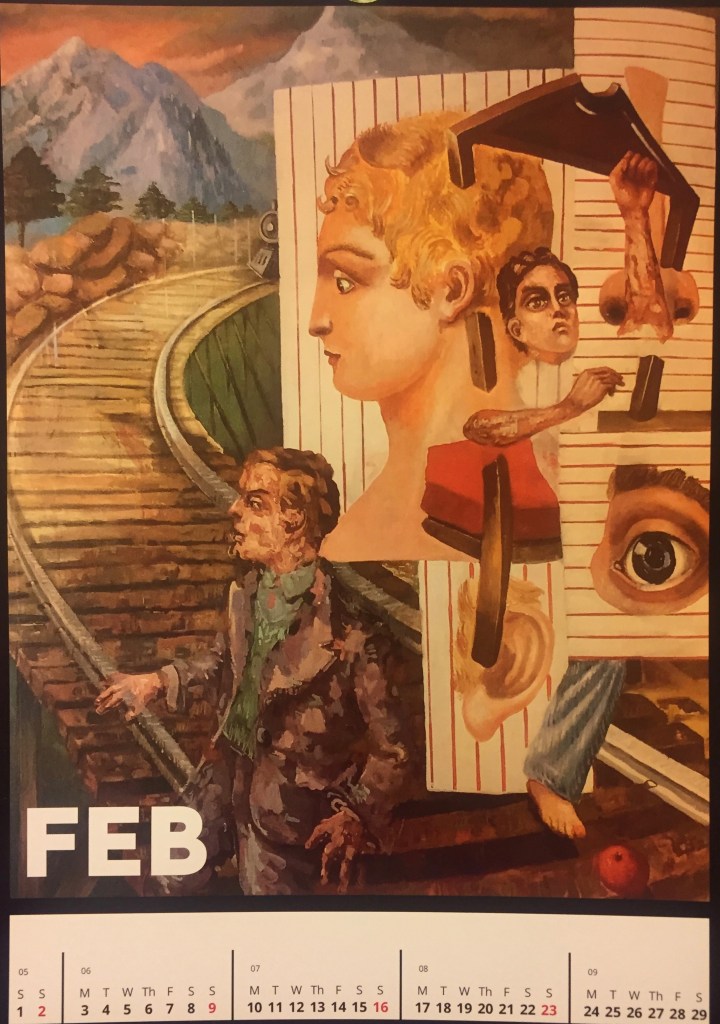
Continuing our 2020 feature of images from our Steven Campbell Calendar, our February selection is: ‘Crash Cubism’ (The Neo-Classical Period).

IMG_0962
Crash Cubism, Oil on Canvas, ©️Steven Campbell Estate

Carol Campbell:

This painting was created as part of Steven’s 1990 exhibition, On Form & Fiction, at the Third Eye Centre Glasgow,  which is now the CCA.

The main gallery space was given over to the installation of a faux museum with large drawings forming the illusion of hand painted wallpaper with the paintings hung as if in a museum setting, complete with benches, table and ‘Je t’aims . . . moi non plus’ playing on a reel to reel tape recorder. In the side room Steven decided to exhibit stand alone large scale oils on canvas ,of which Crash Cubism was one. 

Duncan MacMillan wrote the following in his book on Steven called ‘The Story So Far’:

‘The theme of English twentieth-century aesthetics, it’s particular struggle with Modernism (and it’s deluded belief that art itself held the ‘answer’) seems to be taken up in Crash Cubism.’  

At this point in time Steven was reading a lot about Ruskin and architecture and design in general. His love of film is also part of the fabric that makes this exhibition the tour de force it has been acknowledged to be. Tarkovsky mixed with Westerns throws up a lot of recurring images used both in the installation and the stand alone paintings.

Crash Cubism is seen at that crucial point of danger like many of Steven’s paintings. It’s the ‘still’ from the movie where we the viewer get to see the danger approaching along the trestle track, about to shatter the cubist painting and hurtle our hero/the artist to an unknown fate.


January: Attenti al cane e tutti la Famiglia

January: Attenti al cane e tutti la Famiglia


IMG_0733
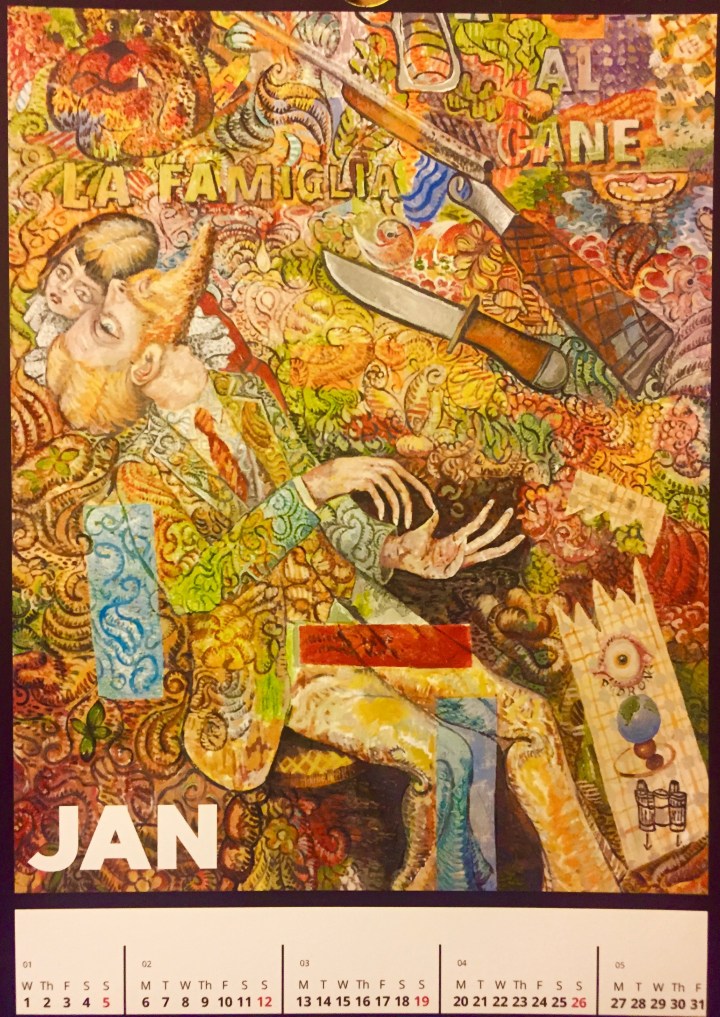
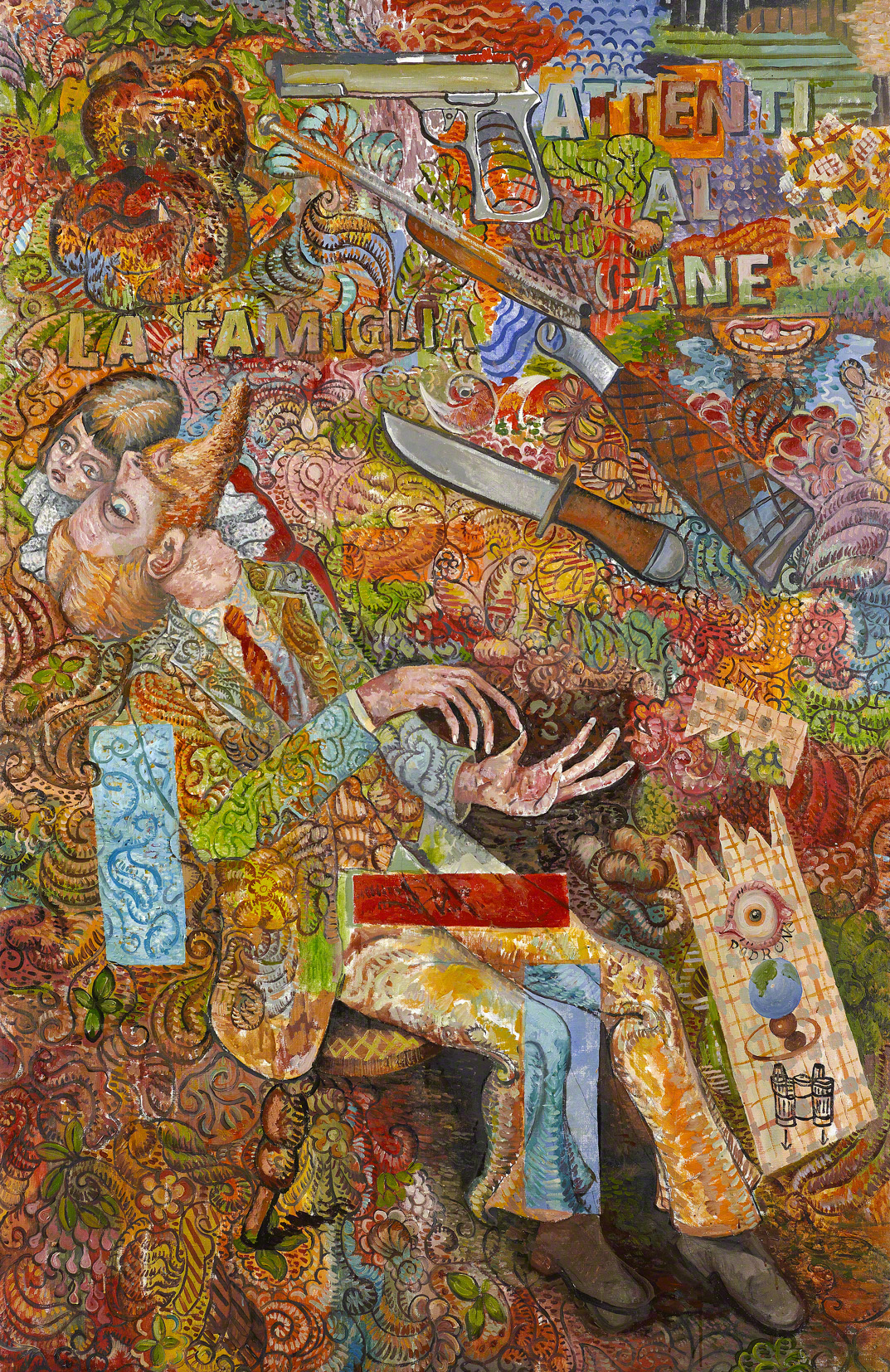
Image Title: Attenti al cane e tutti la Famiglia, translated to English: Beware of the  dog and all the family.


John Ferry, Trustee, The Steven Campbell Trust:

For a number of years now, my fellow Trustees and I (The Steven Campbell Trust) have been delighted to receive as a Christmas Gift from Carol Campbell, a wonderful Steven Campbell Calendar, designed by Carol. These are always cherished and a delightful way to share Steven’s work and to be reminded throughout the year, of his wonderful paintings.

Recently Carol suggested that we make this a feature for our website, so for 2020 we’ve decided to share these works with you, with anecdotes from Carol on each painting.

We wish you a very Happy New Year and hope you enjoy!


Anecdote by Carol Campbell:

This painting was based on an actual sign we saw on the gate of a house in the hilltop village of Paciano in Umbria.

We had eaten lunch in the tiny cafe in the town and went for a wander afterwards and it was then Steven spotted the sign.

I’m embarrassed to admit that lacking a camera to photograph the image he pinched the sign, but at least it was put to good use!

The painting then became realised during his John Byrne, Paisley Pattern period, but you can see the warning and the symbols of the original sign such as the knife, gun and dog.

The Lytton Strachey look alike is Steven, with a nod to our own family with the addition of the little girl.


A Very Happy New Year from The Steven Campbell Trust!

Link to original image:

Image Title: Attenti al cane e tutti la Famiglia, translated to English: Beware of the  dog and all the family.


Steven Campbell article: Luncheon N°8-2

Steven Campbell article: Luncheon N°8-2

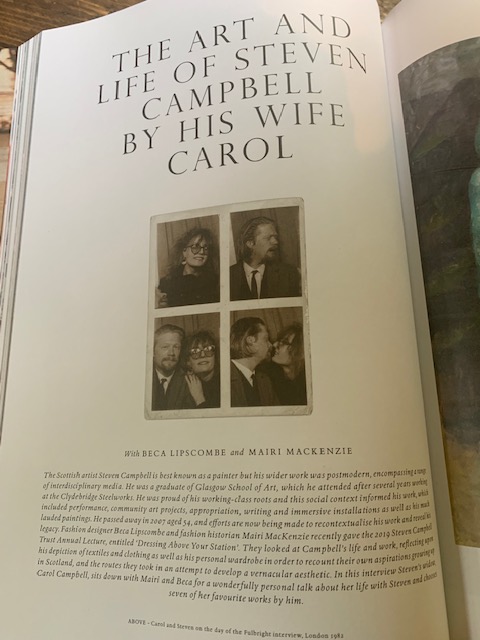
The Steven Campbell Trust are delighted to share the recent publication of: The Art and Life of Steven Campbell by his wife Carol Campbell, published in Luncheon Magazine, 2019.

We would like to take this opportunity to share the introduction with you and provide a link for purchase.

From introduction:

‘The Scottish artist Steven Campbell is best known as a painter, but his wider work was postmodern, encompassing a range of interdisciplinary media. He was a graduate of Glasgow School of Art, which he attended after several years working at the Clydebridge Steelworks. He was proud of his working-class roots and this social context informed his work, which included performance, community art projects, appropriation, writing and immersive installations as well as his much-lauded paintings. He passed away in 2007 aged 54, and efforts are now being made to recontextualise his work and reveal his legacy.

Fashion designer Beca Lipscombe and fashion historian Mairi MacKenzie recently gave the 2019 Steven Campbell Trust Annual Lecture, entitled ‘Dressing Above Your Station’. They looked at Campbell’s life and work, reflecting upon his depiction of textiles and clothing as well as his personal wardrobe, in order to recount their own aspirations growing up in Scotland, and the routes they took in an attempt to develop a vernacular aesthetic’.

In this interview Steven’s widow, Carol Campbell, sits down with Mairi and Beca for a wonderfully personal talk about her life with Steven and chooses seven of her favourite works by him.

Above: Carol and Steven on the day of the Fulbright interview, London 1982.

Purchase link:

Luncheon Issue 8-2

https://www.kdpresse.com/en/LUNCHEON/

Love: A Very Particular Vision

Love: A Very Particular Vision

Love: A Very Particular Vision

Exhibition Publication

19 January – 25 March 2018 

Publication: Love_StevenCampbell_webversion_v.2

Love was an exhibition of twelve large scale multi-media collages made between 1988 and 1991 by Steven Campbell, one of Glasgow’s most celebrated artists. The exhibition was curated by Linsey Young, 19th January – 25th March 2018, Tramway, Glasgow.

Campbell began the works on his return to Scotland in 1987 following a five year period of living and working in New York. The collages represent a little known, experimental  area of  Campbell’s practice which also includes clay, plaster and papier mache sculpture, drawing, printmaking and textile design.

While Campbell’s paintings were often executed with terrific speed – a canvas, he claimed, could be completed in five days – these large scale, predominantly two- dimensional collages were each made over a period of weeks, in part because of the laborious way in which the artist chose to work with material (hand painting and then adhering individual strands of string rather than painting once they were integrated into the collage). However the artist’s wife Carol Campbell has also attributed this change of a pace to a need for an activity to accompany a period of reflection and contemplation, a form of therapy through which Campbell could come to terms with the changes in his life following the family’s return from America.

Completed at the kitchen table, amid the rhythms of family life the resulting collages are testament to Campbell’s modest needs, his restless imagination and experimental nature but perhaps even more so to his sensitivity to the world around him. In these works we see a manifestation of the most powerful cornerstones of his life, his family, the natural world and his boundless imagination.

Love was curated by Linsey Young in collaboration with Tramway. The exhibition was accompanied by a catalogue including a new essay by Michael Bracewell, supported by Creative Scotland, a copy of which we are pleased to share online for the first time.

Graphic design –  Varv Varv  http://www.varvvarv.eu/

Steven Campbell Annual Lecture 2019, Dressing Above Your Station

Wed 12 June 2019

CCA, Sauchiehall Street, Glasgow.

6.30pm, Free (unticketed), Theatre / All ages.

Steven-Campbell-by-Lord-Snowdon-1987-r-e7ku
Steven Campbell by Lord Snowdon, 1987, reproduced with the kind permission of Snowdon Archive and Condé Nast.

Beca Lipscombe and Mairi MacKenzie look at the life and work of Steven Campbell, considering what it means to dress for the life you want rather than dress for the life you have. They will reflect upon Campbell’s depiction of textiles and clothing as well as his personal wardrobe in order to recount their own aspirations growing up in Scotland and the routes they took in an attempt to develop a vernacular panache.

Beca Lipscombe is a fashion and textile designer and one half of Atelier E.B. Mairi MacKenzie is a fashion historian and Research Fellow in Fashion and Textiles at Glasgow School of Art.

Steven Campbell: Love

Screen Shot 2018-01-15 at 19.17.33


Tue-Fri 12 – 5pm
Sat & Sun 12 – 6pm
CLOSED Mondays

PREVIEW: Friday 19 January, 7-9pm

Love is an exhibition of twelve large scale multi-media collages made between 1988 and 1991 by Steven Campbell, one of Glasgow’s most celebrated artists.

Campbell began the works on his return to Scotland in 1987 following a five year period of living and working in New York. The collages represent a little known, experimental  area of  Campbell’s practice which also includes clay, plaster and papier mache sculpture, drawing, printmaking and textile design.

While Campbell’s paintings were often executed with terrific speed – a canvas, he claimed, could be completed in five days – these large scale, predominantly two- dimensional collages were each made over a period of weeks, in part because of the laborious way in which the artist chose to work with material (hand painting and then adhering individual strands of string rather than painting once they were integrated into the collage). However the artist’s wife Carol Campbell has also attributed this change of a pace to a need for an activity to accompany a period of reflection and contemplation, a form of therapy through which Campbell could come to terms with the changes in his life following the family’s return from America.

Completed at the kitchen table, amid the rhythms of family life the resulting collages are testament to Campbell’s modest needs, his restless imagination and experimental nature but perhaps even more so to his sensitivity to the world around him. In these works we see a manifestation of the most powerful cornerstones of his life, his family, the natural world and his boundless imagination.

Love is curated by Linsey Young in collaboration with Tramway. The exhibition will be accompanied by a catalogue including a new essay by Michael Bracewell, supported by Creative Scotland.

The Art of Steven Campbell 13 September 2017 – 21 October 2017

Marlborough Fine Art is pleased to present a retrospective of celebrated Scottish painter Steven Campbell. The show consists of a selection of works made between 1983 and his untimely death in 2007.

This major exhibition is a rare insight into the career of an artist who is considered to have pioneered the renaissance of Scottish art in the 1980s. It is the first major exhibition in London since his solo show at Marlborough Fine Art in 2009.

Best known for his monumental figurative paintings, Campbell’s unique works emerged from an array of personal and literary inspirations to create surreal narratives which offer Campbell’s comment on social and human conditions. His paintings often depict recurring characters in dream-like scenarios, which are full of humour and ironic historical references.

Campbell enrolled at Glasgow School of Art in 1978, studying installation and performance art, which became influences within his theatrical paintings. Towards the end of his studies, Campbell was awarded the prestigious Fulbright Scholarship and moved to New York in 1982 where he made an impression on the art scene, receiving acclaim for his thought-provoking works.

Campbell moved back to Glasgow in 1987, during this time his work became more expressive. As figurative painting became less fashionable in the 1990s, this proved a difficult period for Campbell and he started to experiment with different materials and themes within his work. Solemn undertones and dark irony became recurring themes, reflecting his own personal struggles during this period.

Despite the variations and changes within his practice over the years, Campbell’s works present a highly distinctive and original aesthetic, in an intelligent, powerful and a sometimes autobiographical style of painting.

The exhibition is accompanied by a fully illustrated catalogue with an introduction written by novelist Michael Bracewell.

Besides several solo exhibitions in the USA in the 1980’s, Campbell also held exhibitions in Munich (1984), Geneva (1986), and Tokyo (1990). In 1990, the Third Eye Centre, Glasgow, organised a major touring exhibition of his work ‘On Form and Fiction’, which was seen in Oriel Mostyn, Llandudno; Marlborough Fine Art, London; Art Gallery, Aberdeen; Whitworth Art Gallery, Manchester and Art Gallery, Southampton. His final major exhibition was The Caravan Club at Talbot Rice Gallery in Edinburgh in 2002.

Campbell’s work can be found in major museums and public collections including; Arts Council of Great Britain (UK), Metropolitan Museum of Art (USA), Art Institute of Chicago (USA), Scottish National Gallery of Modern Art (UK), and Tate Britain (UK).


http://www.marlboroughlondon.com/exhibitions/the-art-of-steven-campbell/


Campbell_f_Autumn-No-Happy-time-if-you-have-a-heartbeat_2001-2002
Steven Campbell, Autumn No Happy time if you have a heartbeat, 2001-2002

Ruth Inge Hardison

01

Inge Hardison, left, in 1957, with a sculpture she donated to Mount Sinai Hospital in Manhattan. Her daughter, Yolande, unveils the work, with the help of Martin R. Steinberg, hospital director (Credit Allyn Baum/The New York Times)

During my time in New York, I had the pleasure of meeting and working with many interesting and creative figure models, all of whom contributed to my collaborative myth-making project. One model who came to my studio to participate was Yolande Hardison, who truly entered into the spirit of the collaboration, working with another model called Daniel to create dynamic and theatrical scenes that I certainly couldn’t have conceived of alone. The 2 hour session in my studio with Yolande and Daniel was enormous fun, with lots of laughter and creativity.

02

Yolande Hardison with a poster cataloguing some of her late mother Inge Hardison’s achievements

After our collaboration was over, Yolande told me a little bit about her mother, the late sculptor, photographer and actress Ruth Inge Hardison (you can see the two of them together in 1957, in the image at the top of this blog post). Yolande spoke about her mother’s work with such passion and enthusiasm, painting a vivid picture of what Inge Hardison was like as a person. Yolande is currently in the process of planning a book about her mother’s career, in which she hopes to provide insight into Inge Hardison’s life from the perspective of a daughter who loved her and knew her well – offering a different sort of reading experience to art books that tend to only focus on the professional, rather than the personal.

03

Yolande’s apartment, packed with her mother’s art

A week after her modelling session, Yolande was kind enough to invite my boyfriend Brian and I to her apartment on the upper West side of Manhattan, where we were given the opportunity to see some of her mother’s work. The living room was packed with an array of sculptures from every stage of Inge Hardison’s career, the walls covered in her black-and-white photographs that beautifully captured the everyday lives of people in her community. As well as preserving and displaying her mother’s artwork, Yolande has started the time-consuming process of cataloguing articles and documents related to her mother’s life and art career.

04


05

06

There are various online sources available in which you can find out more about Inge Hardison (links are provided at the bottom of this page), but I’ll give a brief overview of her life, so that you can see what a privilege it was to view such an extensive collection of her work, and find out what she was like as a person. The information below is quoted directly from the article, Inge Hardison at 100, A Century of Expression in Life and Art, by Alice Bernstein (http://iraaa.museum.hamptonu.edu/page/Inge-Hardison-at-100).

07

‘Ruth Inge Hardison was born in Virginia in 1914.  Soon after her birth, her parents fled Jim Crow racism and segregation, settling in Brooklyn. After graduating from high school, she landed the role of “Topsy,” the enslaved child in the 1936 Broadway production of “Sweet River,” George Abbott’s adaptation of Uncle Tom’s Cabin. Her portrayal of the slave girl whose brutal treatment doesn’t kill her wit and kindness won her rave reviews. She also appeared in “The Country Wife” with Ruth Gordon, and in the 1946 production of “Anna Lucasta,” co-starring with Ossie Davis and Ruby Dee.

‘In the midst of all this, Inge Hardison discovered clay and was swept by the beauty and power of this material coming from the earth and, with it, her own ability and passion to express herself in this art form. She is best known for a series of bronze busts, begun in 1963, of African Americans who fought slavery and led the struggle for civil rights, and who at that time had not yet been acknowledged in the National Hall of Fame in Washington, DC: Frederick Douglass, Sojourner Truth, Harriet Tubman, and Dr. Martin Luther King.

‘One sees palpably in her work her great respect for those who helped change history, as in her series, “Ingenious Americans,” which includes Benjamin Banneker (1731-1806) surveyor, clock-maker, mathematician; and Garrett Morgan (1877-1963), inventor of early traffic lights and gas masks. She also sculpted large public works: a life-size bronze, Mother and Child (her gift to Mt. Sinai Hospital in Manhattan after the birth of her daughter Yolande’.

Source: Inge Hardison at 100, A Century of Expression in Life and Art, by Alice Bernstein (http://iraaa.museum.hamptonu.edu/page/Inge-Hardison-at-100).

08

As well as being inspired by Inge Hardison’s work, one of the things I found most personally touching about my trip to the apartment was hearing her daughter Yolande’s stories about her. Yolande showed Brian and I a lovely video taken during Inge Hardison’s 100th birthday celebration, at which her mother was able to give an inspiring and motivational speech, in spite of her Alzheimer’s, which at that stage in her life was very advanced. Yolande also read us a short story that she wrote about her mother – describing a trip they took together to a local park, which captures beautifully a fleeting moment in time, giving insight into the nature of their relationship. After hearing this story, I’m very much looking forward to reading Yolande’s book about her mother when it’s released.

09

I was also very interested to learn that Yolande got into life modelling after being sculpted by her mother when she was just a little girl (see above image).

10

Just before Brian and I left Yolande’s apartment, she very kindly gifted me a brooch, whose design is based on her mother’s sculpture of the abolitionist and women’s rights activist Sojourner Truth (https://en.wikipedia.org/wiki/Sojourner_Truth), along with a typed copy of her own short story. These are wonderful mementos of my time in New York, which I’ll treasure along with my memories of seeing Inge Hardison’s work and legacy.

11

To find out more about Inge Hardison, please follow the links below:

http://iraaa.museum.hamptonu.edu/page/Inge-Hardison-at-100

https://www.nytimes.com/2016/04/06/arts/design/inge-hardison-actress-and-sculptor-of-heroes-dies-at-102.html?_r=0

http://www.culturetype.com/2016/03/31/sculptor-inge-hardison-who-paid-tribute-to-african-american-legends-has-died/

http://naturallymoi.com/2016/04/why-we-should-remember-inge-hardison/