The Saltire Society in conjunction with the Steven Campbell Trust have recently announced the recipient of the first New York Scholarship at the Arts in Public Places Awards in Edinburgh. Claire Paterson, a Graduate of Glasgow School of Art, was successful in being selected for the £13,000 bursary which will see her take up a residency with the prestigious International Studio and Curatorial Programme (ISPC) in Brooklyn. As well as admiring Claire’s work the judges were impressed with her professionalism and her commitment to collaboration which was a key part of her proposal.
The judges stressed the extremely high quality of the entrants and the difficulty in coming to a decision. Artist’s selected for final interviews were: Rory Price, Mark Doyle, Robert Powell and Michael White. All received a cash sum towards art materials as recognition of their work.
The collaboration with the Steven Campbell Trust, which was founded in memory of renowned Glasgow-born artist Steven Campbell, is part of the Saltire Society’s Enlighten programme, launched as part of the Society’s 80th anniversary celebrations.
The Steven Campbell Trust wishes to thank The Saltire Society for their partnership and valued support in this joint venture. We would also like to wish Claire Paterson great success for her forthcoming residency and look forward to following and supporting this exciting initiative in the coming months. Finally, we would like convey our sincere thanks to the high quality of all artist’s interviewed, which made our task in choosing the successful candidate a very difficult one.
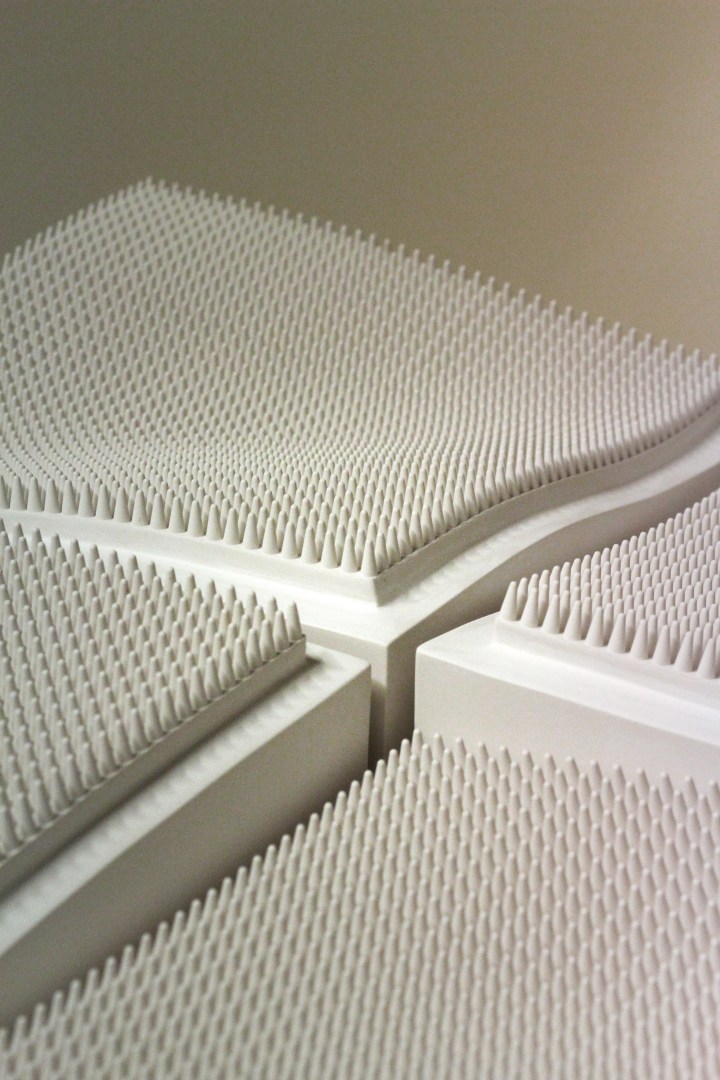
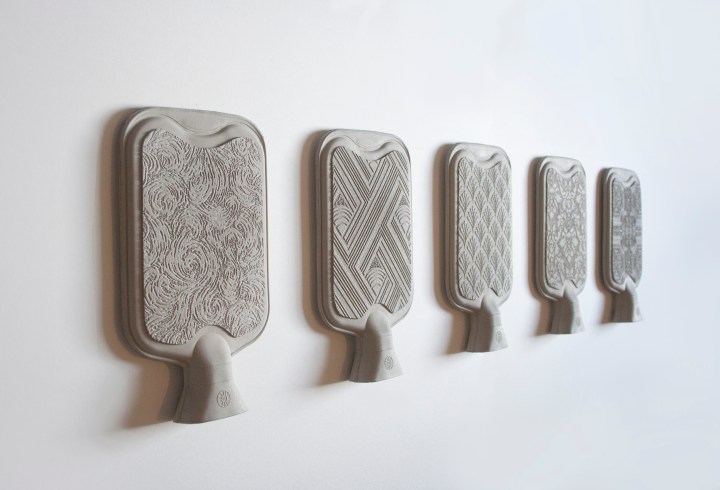
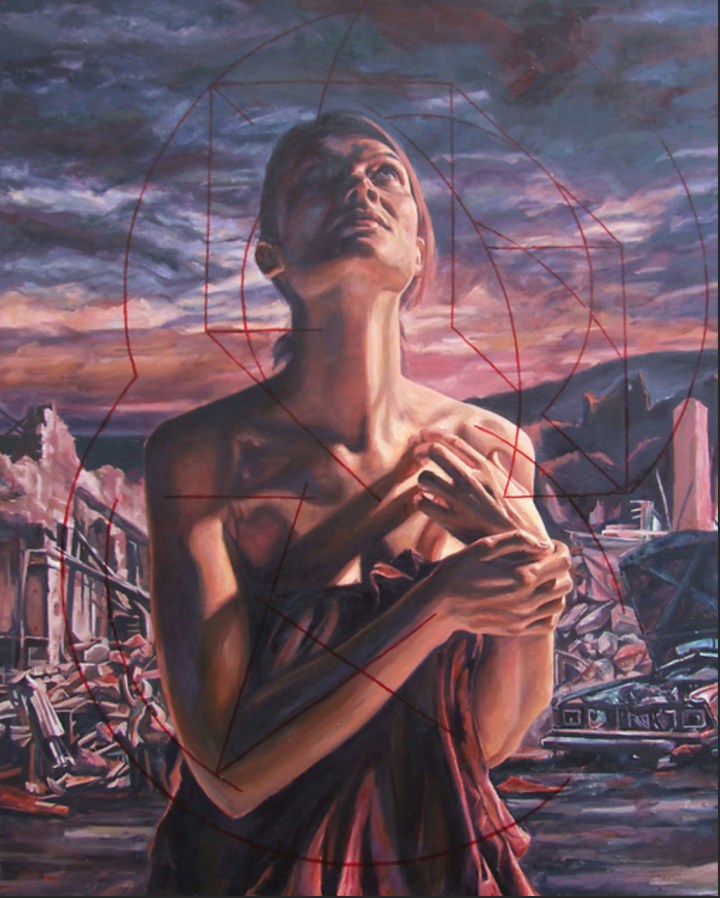
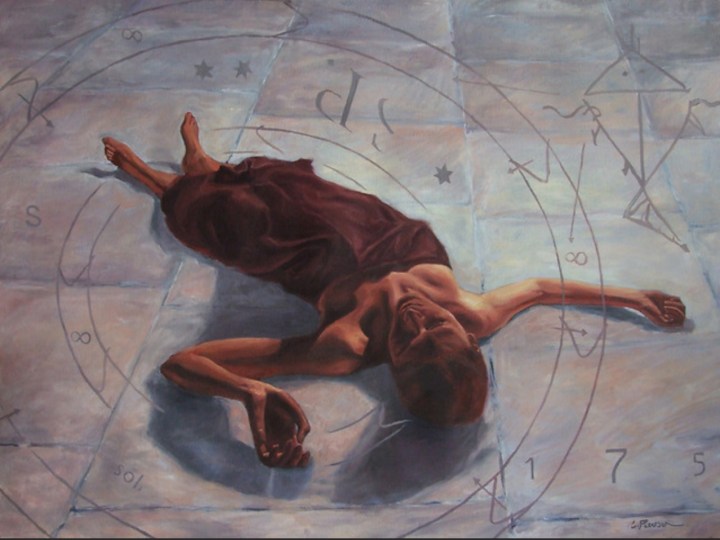
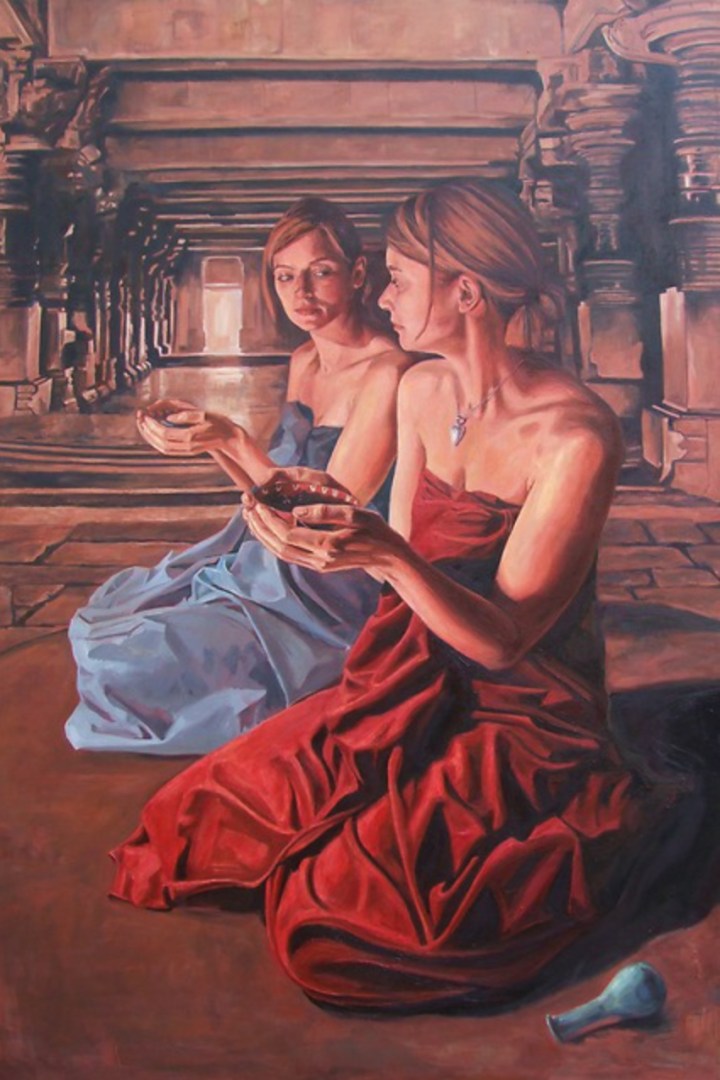
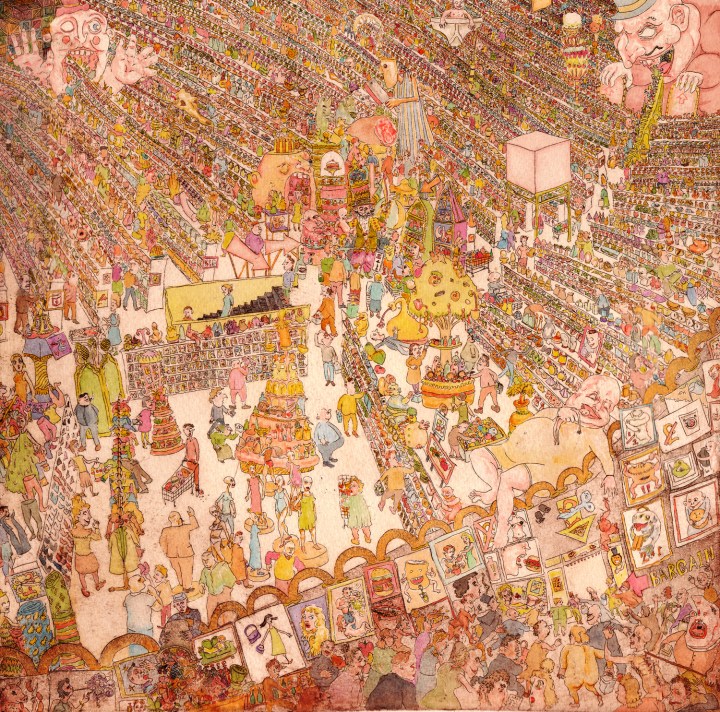
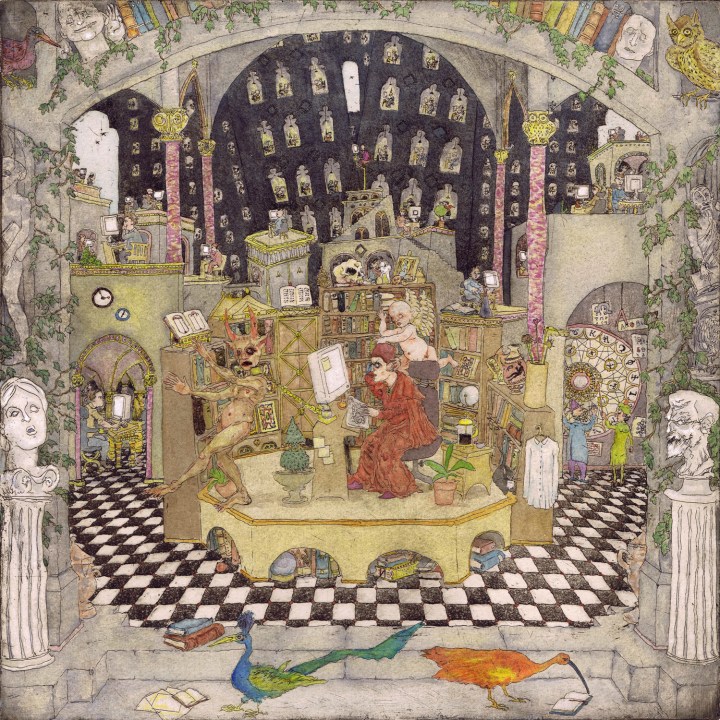
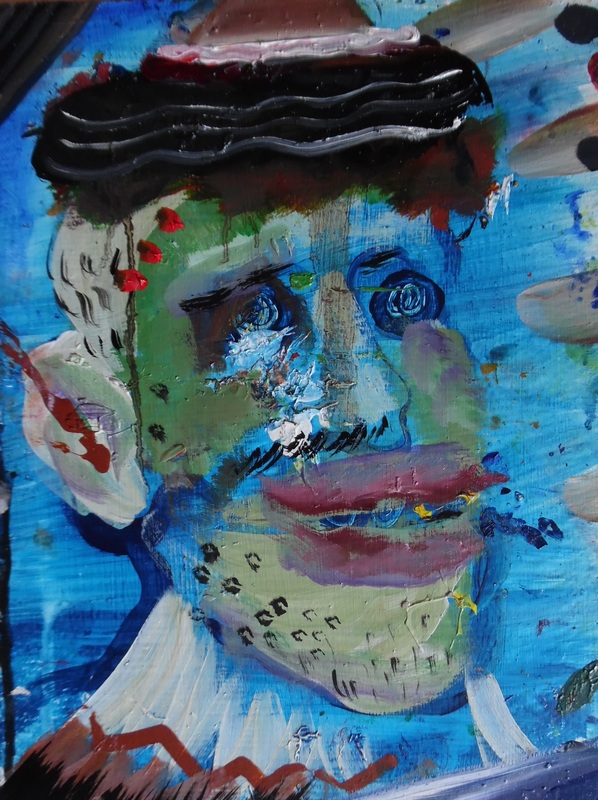
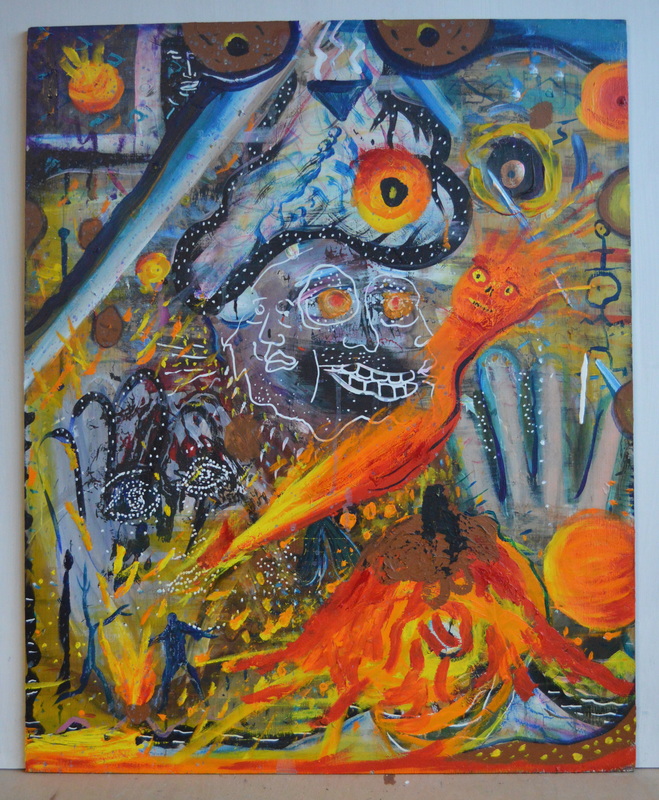
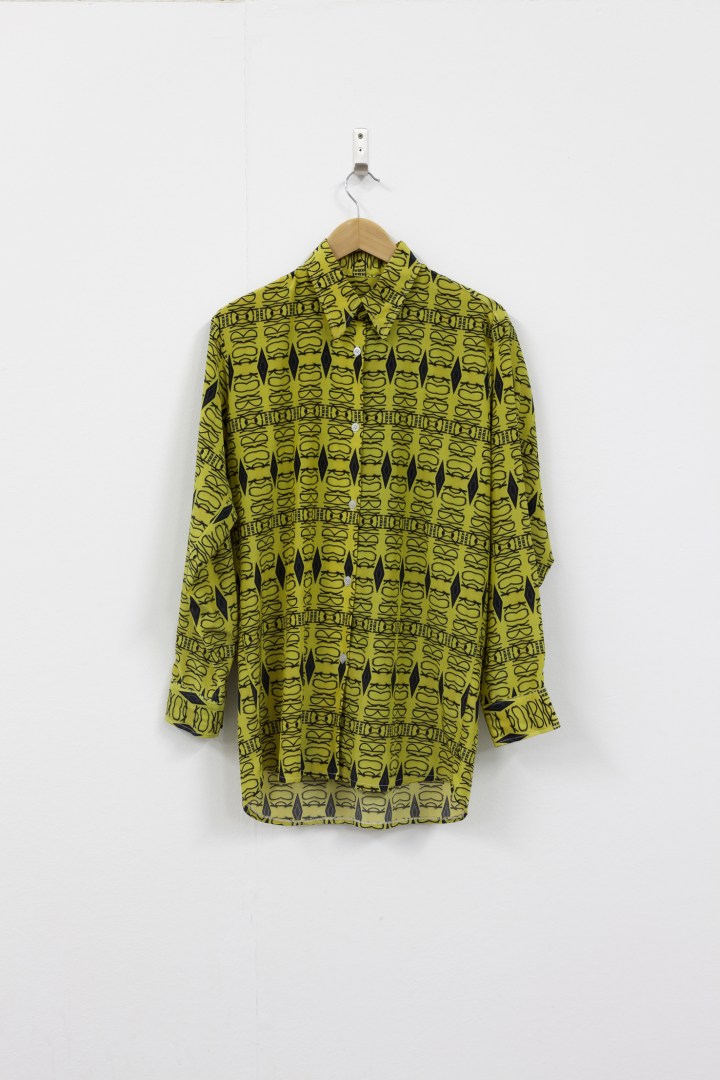
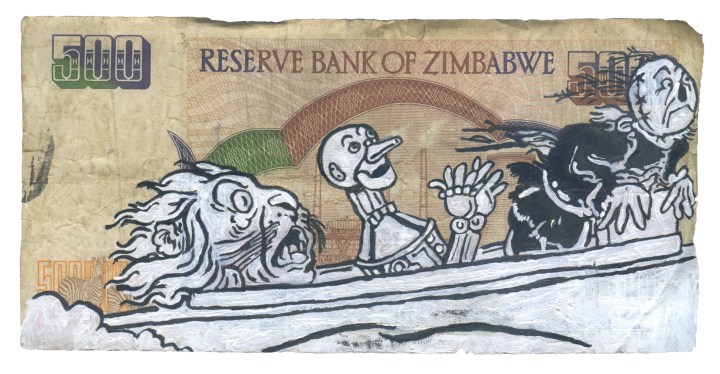
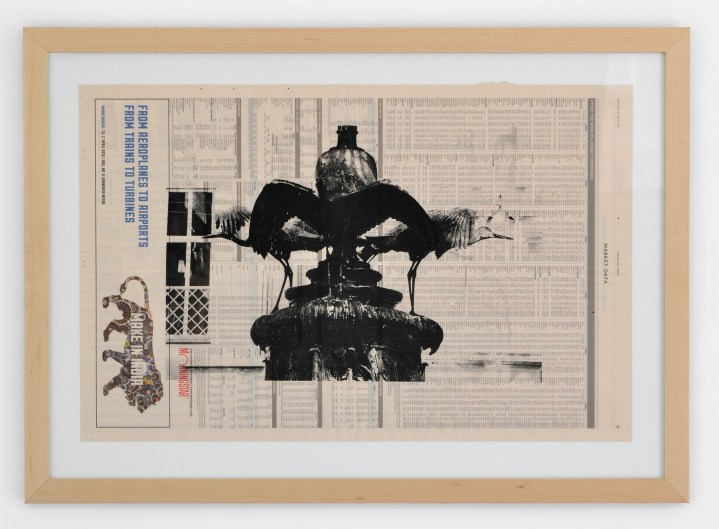
We are delighted to highlight selected works from all artist’s concerned below:
The search is on for an aspiring Scottish artist to spend a fully funded three month residency in New York, made possible through a collaborative initiative between the Saltire Society, the Steven Campbell Trust, International Studio and Curatorial Programme (New York) and Creative Scotland.
The scholarship will involve a three month residency as part of the International Studio and Curatorial Programme (ISPC) in Brooklyn. The winning artist will be given dedicated studio space and the unique opportunity to work alongside 45 fellow artists in residence. The winner will also be the first Scottish artist ever to have received a place at this internationally recognised studio.
The Steven Campbell New York Scholarship is part of a wider £50,000 programme of bursaries to support young and emerging Scottish artists, recently unveiled by independent charity the Saltire Society to help celebrate its 80th anniversary year.
The late Steven Campbell is widely recognized as one of the most significant Scottish artists of his generation. Born in Glasgow, Campbell was a student of Glasgow College of Art and went on to gain a Fulbright Scholarship, which he used to go to New York to study at the Pratt Institute before returning to live in Glasgow in 1986. His widow Carol Campbell founded the Steven Campbell Trust following his death in 2007 with the aim of broadening creative thinking and creative output in individuals and communities of practice in a manner which reflects Campbell’s own international outlook and eclectic and imaginative works.
The scholarship is open to graduates from Edinburgh College of Art, Glasgow School of Art, Duncan of Jordanstone in Dundee, Robert Gordon’s in Aberdeen, and Moray College of Art (University of the Highlands and Islands). The scholarship will fund return flights to New York from Scotland, studio fees at ISCP, accommodation costs in New York and a contribution towards living expenses.
Completed applications must be sent to saltire@saltiresociety.org.uk no later than 12 noon on 17th June 2016.
The successful applicant will be announced at the Saltire Society’s headquarters in Edinburgh on 11th August 2016.
Based on advice from ISCP as to the artists who may benefit most from this experience, the Scholarship is aimed at people having graduated between 2004-2012 inclusive. Applicants must be available to take up the full period of their residency from 1st November 2016 until the 31st January 2017.
We are delighted to see Steven’s work featured in the new Art UK website.
Art UK, is the online home for art from every public collection in the United Kingdom.
Previously called the Public Catalogue Foundation, Art UK is a small charity. They work in partnership with 3,000 public collections, the BBC and other organisations to showcase the art the UK owns.
Art UK already features over 200,000 oil paintings by some 38,000 artists. These artworks are in museums, universities, town halls, hospitals and other civic buildings across the United Kingdom. Most of this art is not on public view.
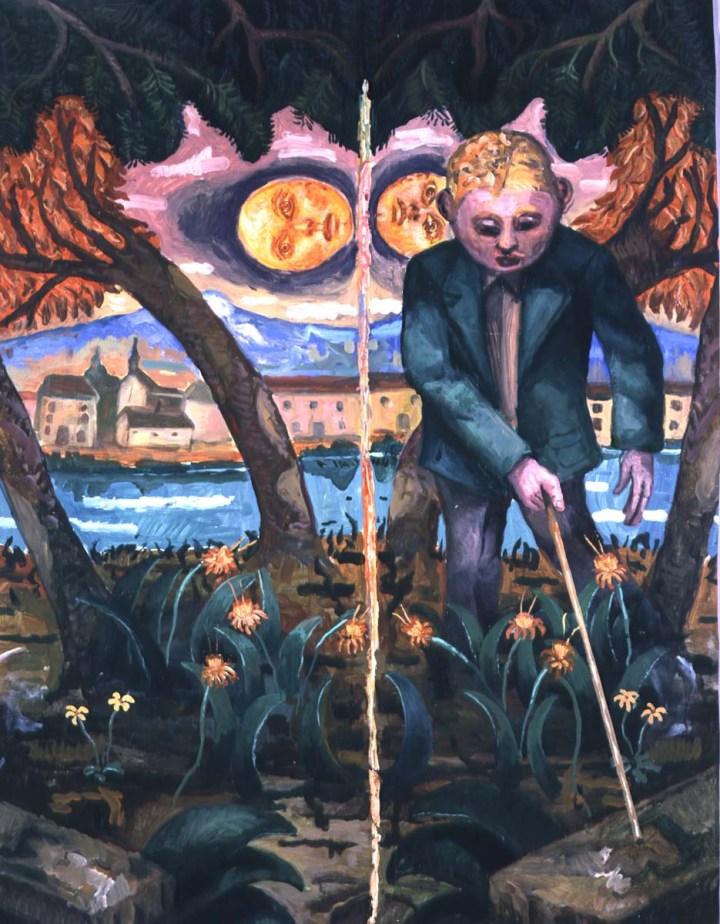
A Blind Man Would Have Great Difficulty Looking at Cezanne
Although a deceptively simple painting, it has a natural beauty with a real sense of place albeit quite surreal.
The background scene is a little town on the bank of the river Saone called Tournus, where we would stop over on route to holidays in Italy. In fact, the family still do, to this day. My grandson Nathan and I will be there this summer.
The journey would progress from Tournus to Aix en Provence, the home-town of Steven’s best-loved artist Cezanne and a pilgrimage to the Jas de Bouffan studio would always be undertaken.
The title of the painting is in relation to that trick of the eye practiced by Cezanne and probably most artists, Steven included of looking at the painting, closing one eye opening it and then quickly closing the other, a sort of winking technique or simply keep one eye closed while looking at an object, scene etc.
“Artists have long known there are two ways of seeing the world”, says University of Oslo Psychology Professor Stine Vogt, Ph.D. “Without learning to turn off the part of the brain that identifies objects, people can only draw icons of objects, rather than the objects themselves. When faced with a hat, for instance, most people sketch an archetypal side view of a hat, rather than the curves, colours and shadows that hit our retina.”
She found that artists eyes tended to scan the whole picture, including apparently empty expanses of ocean or sky while non-artists focused in on objects, especially people. Non-artists spent about 40 percent of the time looking at objects while artists focused on them 20 percent of the time”
So, as the title clearly states, a blind man would have great difficulty with Cezanne.
I knew in 2004, when I first started university that I wanted to create figurative paintings that were of an imaginative style. I’d studied art all through my education, buying numerous books on the Old Greats. It wasn’t until my foundation course tutor, Mick Maslen, introduced me to the artwork of a group of Scottish figurative painters that I really knew the type of artwork I wanted to create. One of those artists was Steven Campbell.
My tutor handed me the book, ‘The Paintings of Steven Campbell, The Story so Far.’ The paintings inside were totally fresh and new to me. They drew my curiosity as they were full of story, wonder and puzzles. I had always read art books but hadn’t really sat down and read a proper book since school. As I discovered Campbell’s love of the books of P.G Wodehouse I thought by reading them I would find more clues to his paintings. I was planning a trip to Edinburgh to drop a painting off at a gallery and thought this would be a great opportunity for a read so I bought ‘Carry On Jeeves’ by Wodehouse. The book was full of quirky characters and hilarious stories. I thought these characters could be, on some level, the figures in Campbell’s paintings. This was great, these books were almost a dialogue for the artworks and I began reading more and more of them.
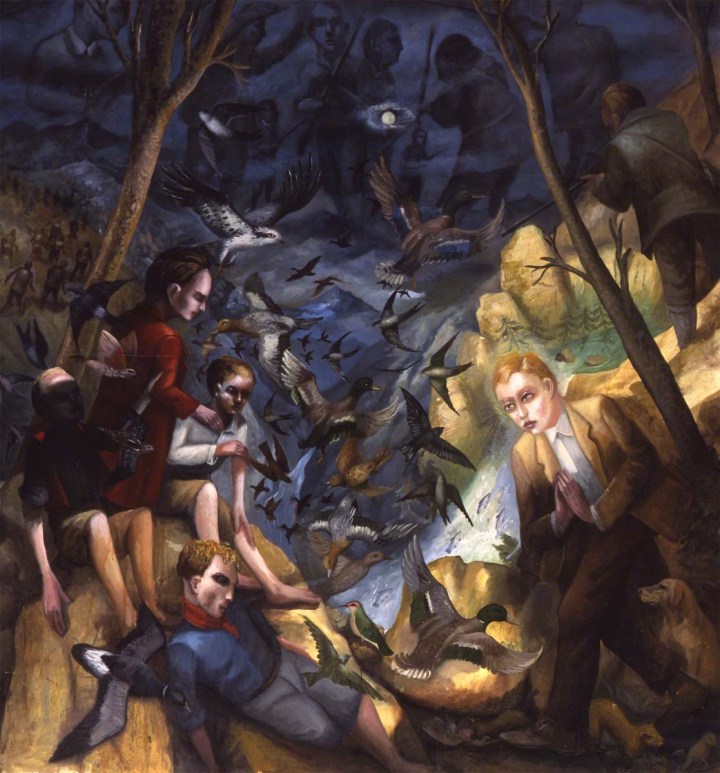
I’ve decided to talk about a painting that was probably the first image of Campbell’s work that I saw. It’s the image used for the front of a book my tutor handed to me. The painting is called ‘Painting in Defence of Migrants.’ Although painted in 1993 the image and subject are actually very appropriate given current events in the world today. The work shows a group of migrants exhausted from their travels, sitting high up next to a waterfall. They are spot-lit; the sky is dark with heavy clouds hanging over them with subtle silhouettes of men with guns drifting among them. Hunters or Soldiers? Perhaps in hot pursuit of the weary travellers?
Painting In Defence of Migrants
The composition of the painting is circular, your eye moves around the painting, led by limbs, faces, and nature. Circular? Could this be on purpose to show that the travellers have been walking in circles themselves? Two trees sit either side of the painting, sheltering the group. The tall trunks lean towards each other forcing your eye down a valley filled with birds and fish; they too are migrants. The fish swim against the flowing waters of the river. They are most likely as tired as the people, fighting the current. A man with blonde hair is slightly more spot-lit than the others in the group, his hands placed together as though he is praying. The fish and water behind him are glowing. Has his prayer been answered as nature provides the fish that could be the food the travellers need to gain the energy to carry on? He is also the only one standing and is taking a step forward, a hopeful man not willing to give up. The birds swoop and glide over the landscape, littering the sky like the Hitchcock film, but these birds are not menacing. I feel they represent hope, a rescue party!
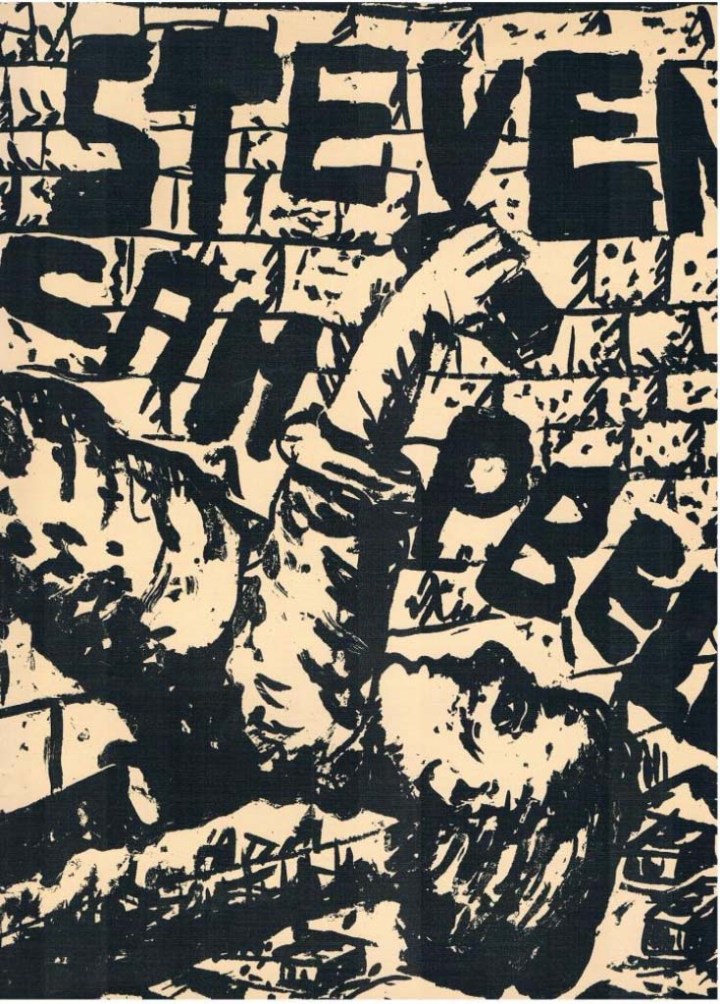
Since first seeing that book I’ve managed to collect a lot of exhibition catalogues of various Steven Campbell exhibitions from various online sellers. My favourite though, is one from a 1984 exhibition at The Fruitmarket Gallery. They say don’t judge a book by its cover but this one had a very special cover. The cover is cream covered with black brush marks crisscrossing and dotting out a horizontal figure in front of brickwork with the name STEVEN CAMPBELL spelled out boldly. As I picked it up I thought the rear of the cover was ripped, only to discover this was purposely done to reveal a pale blue sky with those same expressive black brush marks shaping out a mountain scene.
The great thing I’ve found in Campbell’s work is that every time I return to look at his paintings I’ll find something new. I feel like a traveller myself when I study them as I’m sure he was when he painted them. One of the things that really draws me to the work is how much you can tell he enjoyed painting these artworks; it’s his playground with endless possibilities.
With thanks to:
Richard Woods
Artist and Damien Hirst Painting Assistant
Member of Steven Campbell Appreciation Group:
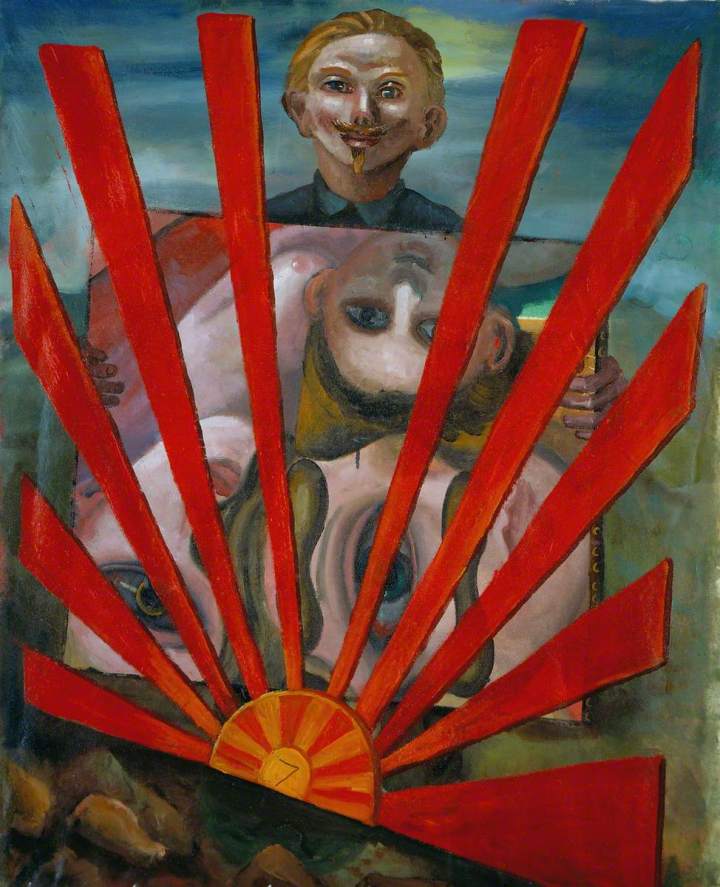
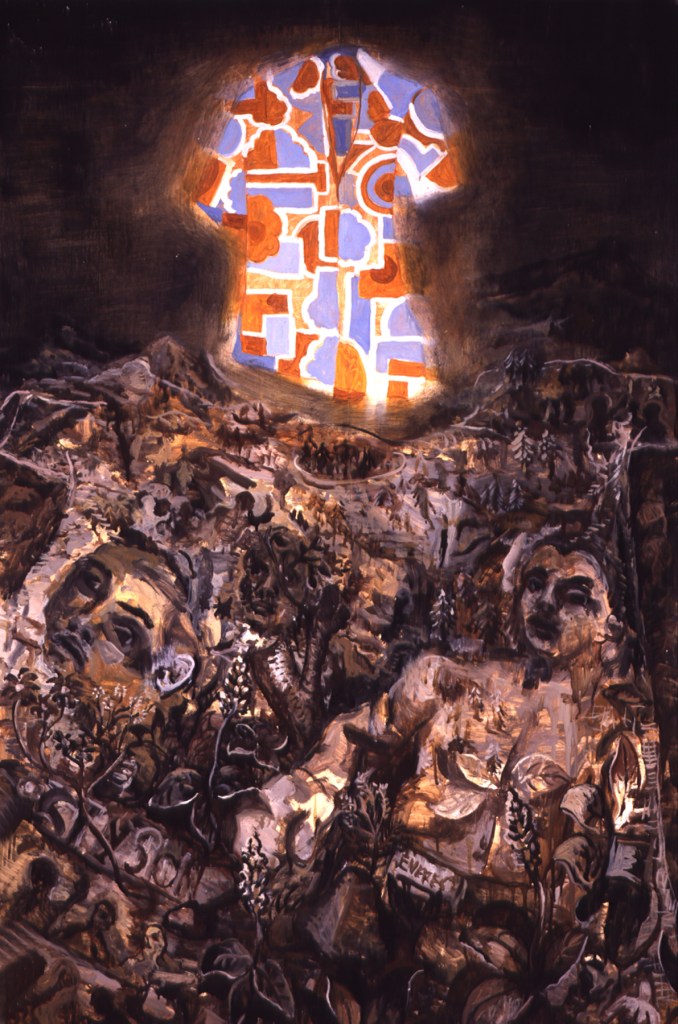
The inspiration for this painting came from a family safari to Kenya. It was just around the time that Mike Tyson was in disgrace, having bit Evander Holyfield on the ear.
We were out one day on route to the game park, traveling through a township market when Steven spotted a black and white printed T shirt featuring Mike Tyson, he got the driver to stop and ran back to buy it.
The t shirt forms the landscape at the bottom of the painting, while Steven’s own holiday shirt (which still hangs in his wardrobe) forms a representation of self while adding another landscape element of sky and sun.
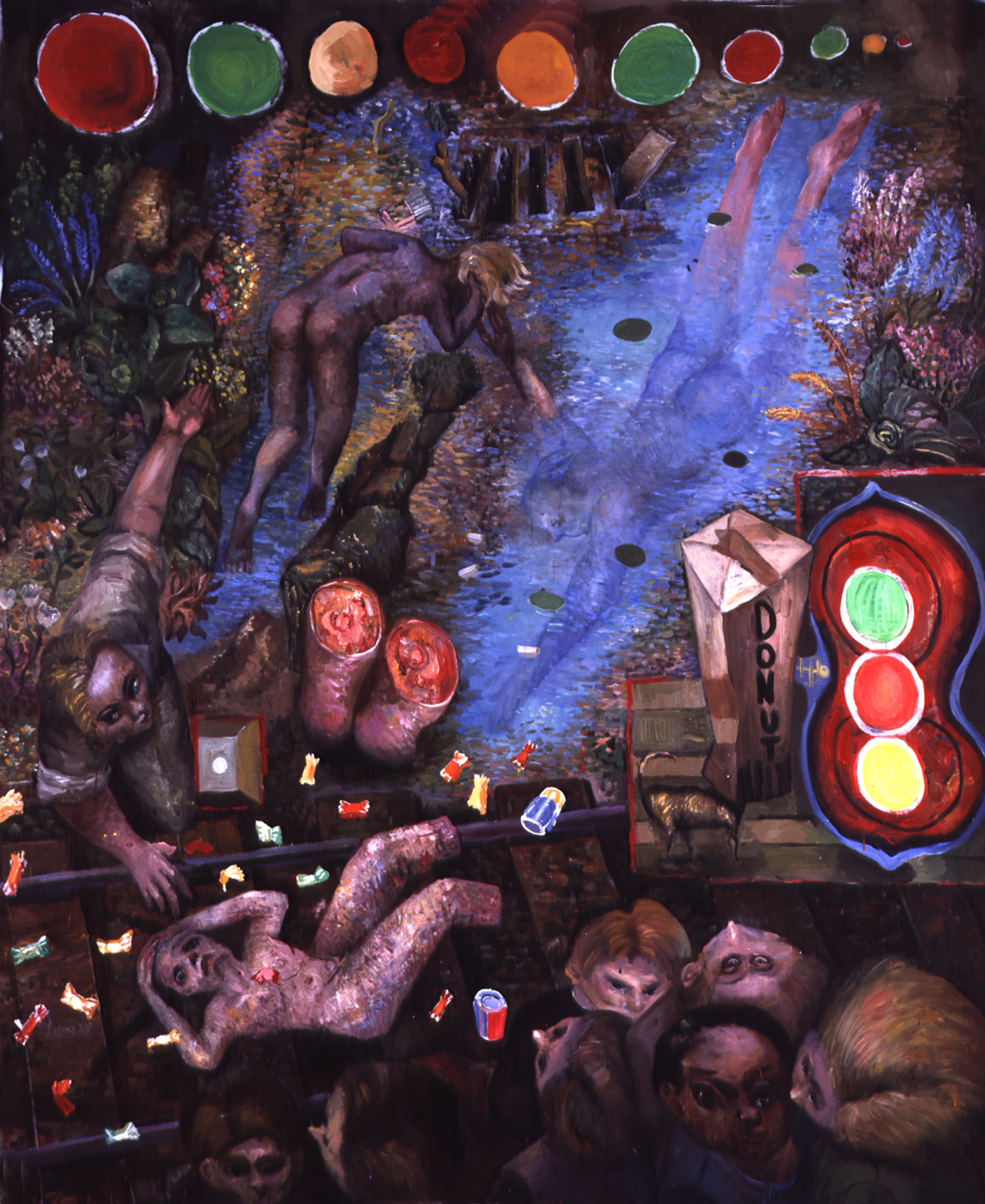
This painting is based on an experience Steven had one Sunday travelling out to his studio in Bed Sty or Bedford Stuyvesant, to give it its full name. He had one change to make on the journey from our loft in Little Italy.
On approaching the platform to continue his journey he found it crowded with people and soon discovered that there had been a suicide attempt (a jumper on the track). Apparently the man was still there with the emergency services so Steven, not wishing to see anything gruesome (unlike the majority of the crowd) went back in the other direction trying to cross to the other platform to return home.
Unfortunately at the same time as Steven was coming down, the paramedics were bringing the injured young black man, who was now screaming and waving two bloody stumps in the air while lying on the stretcher. His legs had been cut off below the knee. So Steven, by trying to avoid being part of the action ended with a ringside seat, which left a very harrowing memory.
So if you look again at the painting you will see the crowds, bottom right, the signal lights, the body with the 2 stumps above it and various bits of detritus floating about.
The donut bag to the right of the picture beside the signal lights has a body of a rat coming out of it and again this comes from an actual memory. This was a different day but Steven has chosen to merge them into the one painting. We were both standing waiting for our local train, the RR, when a donut bag with the back end of a rat sticking out from it came hurtling along the track, the rat had obviously got inside to retrieve a left over piece of donut and had gotten stuck.
This painting is a good example of how Steven would take personal experiences and merge them with imaginative elements to form a cohesive, if somewhat illusive whole.
A still from a movie, where you write the script with your own imagination.
We’re delighted to highlight today’s Observer feature on Rachel Jones, our 2013 Hunt Medal winner. This piece looks at seven decades of artists, interviewing an artist from each decade, featuring Paula Rego, Susan Hiller, Richard Deacon, Rachel Whiteread, Laure Prouvost and of course Rachel.
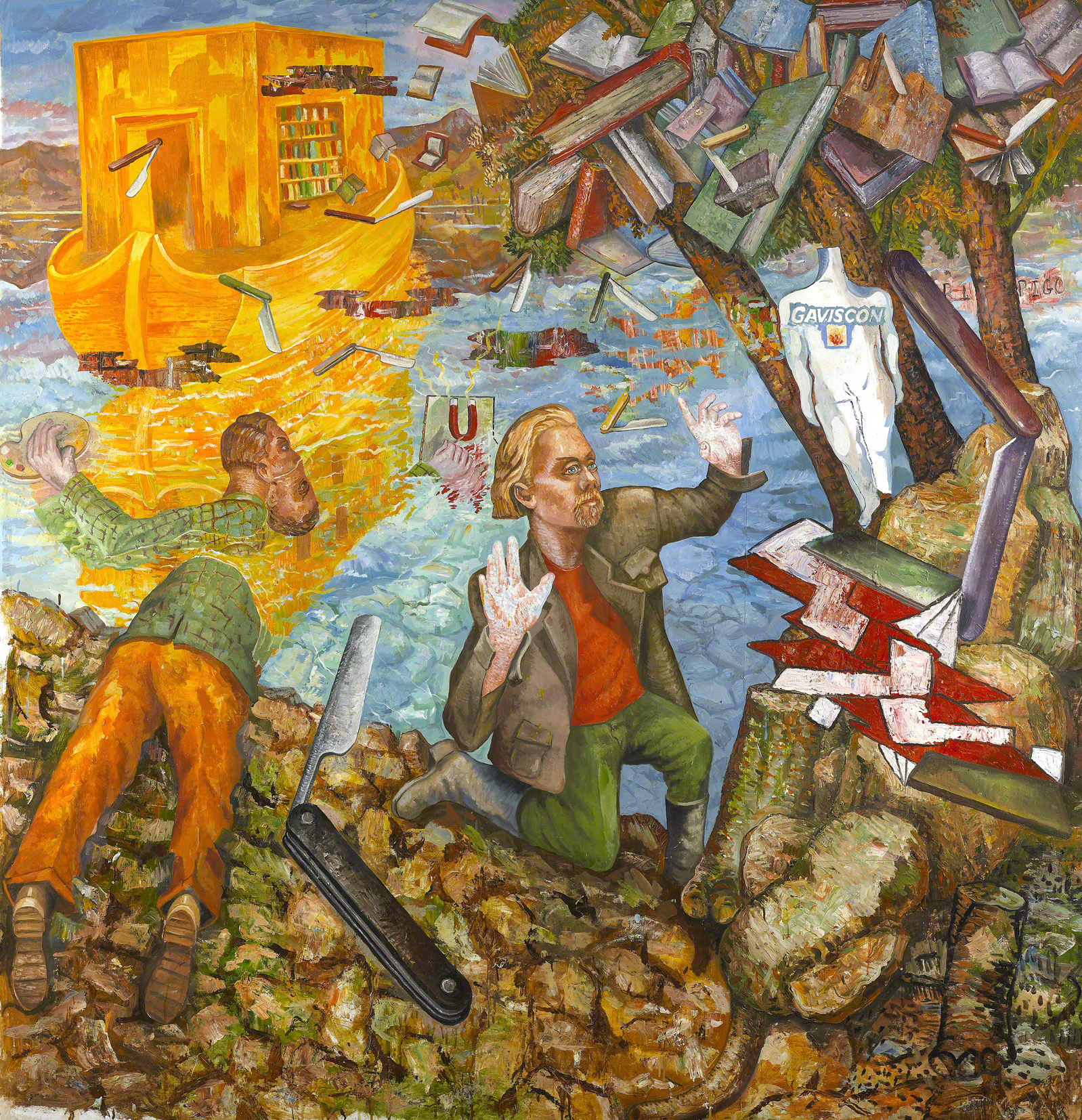
Continuing with our Painting of the Month series, Carol Campbell discusses, Untitled (Gaviscon Series).
This painting shows a kneeling figure with arms outstretched. I would on looking at it now, see it very clearly as a self portrait, and certainly the Gaviscon images are deeply personal and relate directly to the self diagnosed ulcer Steven believed himself to be suffering from, while in reality it was pain from his appendix.
Returning to the other details, most especially the Gaviscon, Steven viewed this as a symbol of self and actually took a bottle with him to Cezanne’s studio at Jas de Bouffan on the outskirts of Aix en Provence. Steven adored Cezanne, considering him the greatest of all painters and by positioning the bottle around the studio on chairs, tables, beside bowls of fruit etc and secretly taking photographs (as photography within the studio is forbidden) felt he had in some way a connection to the man and the place.
The books tumbling down represent years of study both of art and literature cut through with darker thoughts represented by the open razors. The floating figure could be read as either attempting suicide or as a survivor.
Painting of the Month, Special Feature, October 2015
This month we’re choosing to have an additional painting of the month to accompany our Annual Steven Campbell Lecture. It is with great pleasure that we include this short essay by Roger Hoare. Roger was Lecturer at The Glasgow School of Art from 1973 to 1981, where he taught on the short-lived Mixed Media programme between 1977 and 1981. Steven joined the course in his second year in 1979. It was where he made the now iconic Poised Murder performance with a group of fellow students.
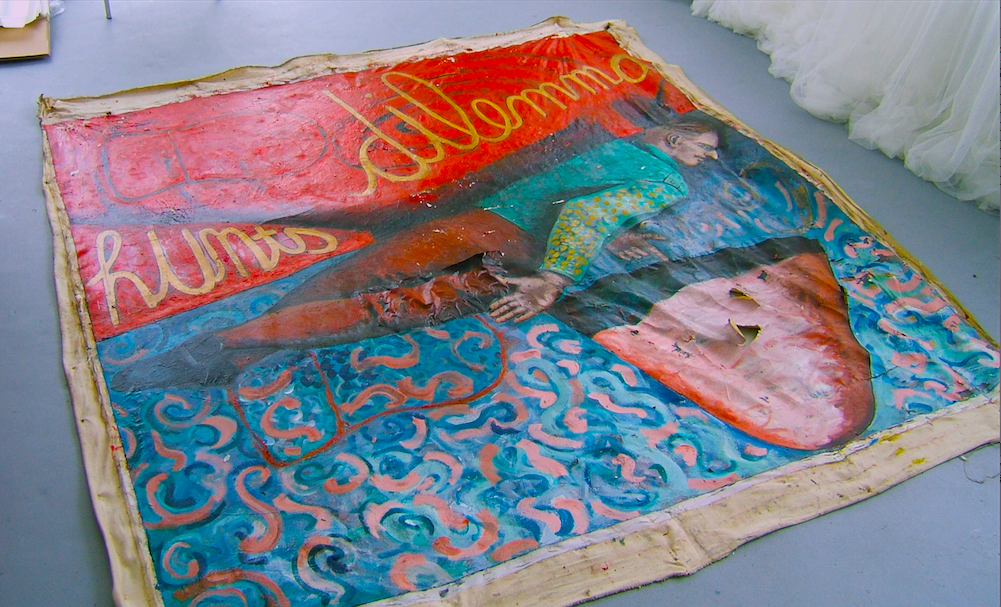
Hunt’s Dilemma
Hunt’s Dilemma
In September 1981 I left Glasgow School of Art after running the Mixed Media Course in the new Fine Art department, to study Chinese art in the Far East. Steven Campbell had been in the final group of about twelve students from September 1980 to June 1981, working above the Victoria Café, opposite the Mackintosh building. Both he and Adrian Wiszniewski were then in their third year, so still had a final year to complete.
During his year in Mixed Media Steven had worked on installation and theatrical performances, culminating in ‘Poised Murder’…. in which I was beaten to death by a dame with a chair leg, whilst on the telephone. It was more disturbing having to wear Brylcreem, a black polo neck and medallion. It’s difficult to be a cool tutor when starring in a student performance.
On my return from Japan in February 1982 I visited Steven in his room in the annexe along Renfrew Street, where Mixed Media was originally based. The course had closed after my departure and the remaining students returned to their usual departments – painting, sculpture, printmaking etc. Steven could not work in the crowded Drawing and Painting studios, hence his retreat to the annexe. (Moral – never despise the importance of annexes in art colleges ….. see also Goldsmiths circa 1987.)
He was working on ‘Hunt’s Dilemma’. We had a conversation about his paintings, which I thought were a confident development of narratives that he had begun in his last term in Mixed Media after the performances. I was impressed by the power of the image of ‘Hunt’s Dilemma’, its crude directness, the strange flag-like composition and the general oddity. The either/or aspect of the bright, hellish red and the other-worldly blue pattern, with the twisted figure suspended betwixt and between, reinforced the mental concept of ‘dilemma’. I remember talking about the hand gestures and referring to the ‘haloed hand’ in Duchamp’s Fauvist portrait of Doctor Dumouchel, 1910.
‘Hunt’s Dilemma’ is a crisis for a fictional character, between the devil and the deep blue sea, between the hell of Fascism (oh! those handsome uniforms and sharp haircuts) and the innocence of peace (the sunlit and seascape patterns of Matisse – no! Sandro Chia more like). But what is the blob … a reference to a mountain? …. and those outlines repeated on both the red and blue areas. Has Guston been here with his big boots?
Who next is going to hove into view? Courbet and Titian, Apollinaire and Duchamp, Hume and Nietzche , John Buchan and ‘Rogue Male’, de Chirico and Magritte, Beckett and Joyce, Gerstl and Bacon, Wodehouse and Chandler……..
This is not a far-fetched list …. Steven and I had discussions about all of them during this period ….. and about pictorial conventions, naming and depicting, word and image, happenstance and conundrums ……. Especially humour in art, accidents in painting.
Steven was very aware of contemporary ideas in Post-Modernism – Baselitz, Immendorf, Schnabel, Longo etc. We talked about an imagined, new history painting of contemporary politics, character and events … wonderful as an idea… but difficult … needing to be painted very fast and skillfully. Steven brought Picasso with him…. the heavy-limbed, post-primitive, post-Cubist Picasso. In our conversation he always had an interesting point of view, a generous mind and was unfailingly humorous and quick-witted.
Steven gave me ‘Hunt’s Dilemma’ from his degree show in 1982. That summer I took it to deepest Surrey, where it lived with me in a damp country cottage for over thirty years, mostly hidden from view in an attic and remaining intact, during two burglaries.
It was painted on rough cotton canvas, probably on top of something else, in thick oil paint, perhaps mixed with printing inks “borrowed” from the silk-screen department of GSA. Money for materials was short in 1982. The paint surface was always fragile, it suffered temperature extremes and was rolled up for two long journeys. It now needs considerable repair and has to be seen again in public.
I’ve given it back to Carol Campbell…. end of my dilemma!
I have never used it as a rug. (see Steven Campbell and Hitchcock).
Steven would appreciate the fact that in my dictionary “dilemma” is wedged between “dildo” and “dilettante”.



 The Steven Campbell Trust