FIRST WEEK IN NEW YORK

Post written by Claire Paterson, winner of the Steven Campbell New York Scholarship

image-1-photograph-of-launch-night-copy

DAY 1 – Tuesday November 1st

I arrived in New York, and booked my very first Uber cab to take me out to my apartment in East Williamsburg.

image-2-new-york-apartment

At the apartment I met my room-mates Ash and Giles, both talented artists who went out of their way to make me feel at home. In the evening I had a wander around the neighbourhood, tracking down a good little coffee shop and taking a walk through a local park that’s bursting with Autumn colours right now.

DAY 2- Wednesday November 2nd

image-3-iscp-entrance

In the morning, I headed into the ISCP, where I met with the staff and 4 other artists who are starting their residencies at the same time as me. I collected my keys and checked out my studio, a great space with huge windows and lots of natural light. I’m on the the 3rd floor with 5 other artists, and we have our own little lounge and kitchen area.

image-4-genevieves-apartment

In the afternoon, I went out to visit my sister G in South Brooklyn, meeting her dog Blue for the first time and getting to see her wonderful, art-crammed apartment.

G had set aside lots of objects and sculptures for me to use in my collaborative myth-making sessions, including pieces by the artists Amber Fleming and Robert Picker (who I’ll talk about in upcoming blog posts).

We booked a cab and travelled back to the ISCP, probably bemusing the driver with all of the sculptures we managed to cram into the boot and on our laps in the back seat. I then worked well into the evening at the ISCP, getting my studio ready for the Open Studio event.
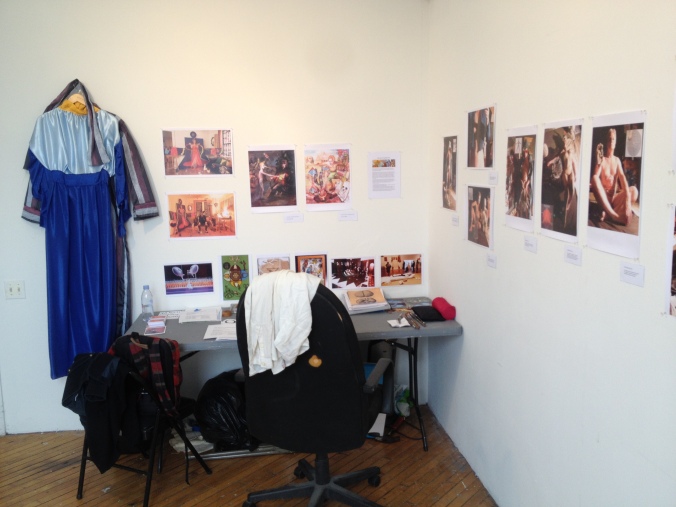
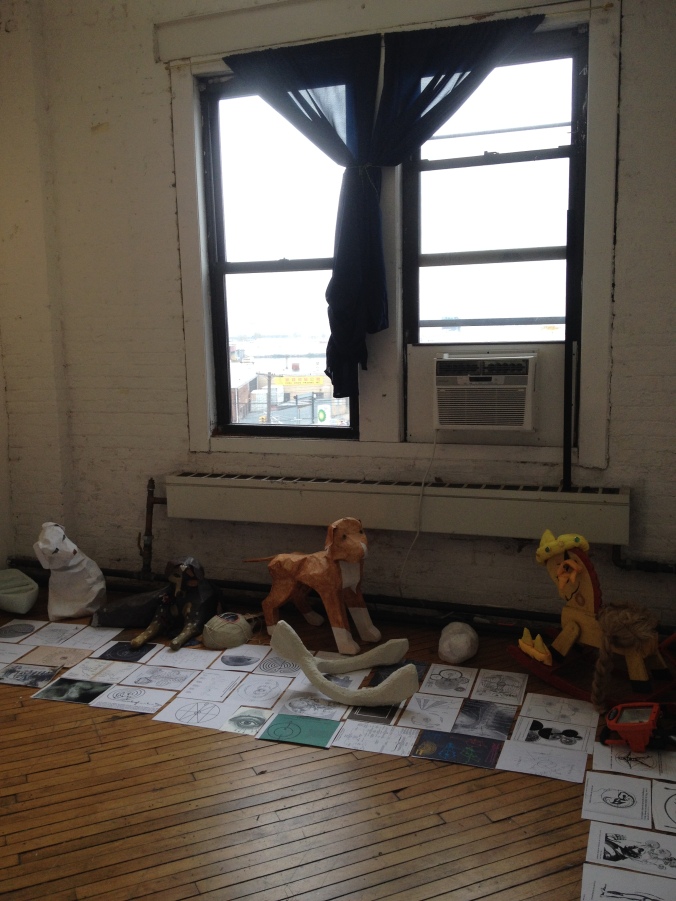
image-7-studio

image-8-studio

image-9-studio

image-10-studio

DAY 3: Thursday November 3rd

image-11-tetsugo-hyakutakes-studio

ABOVE: Japanese artist Tetsugo Hyakutake’s studio (www.tetsugohyakutake.com)

Today the artists in the ISCP opened their studios to each other, so that we could all get some idea of what everyone else on the residency is getting up to.

image-12-john-aslanidis-studio

ABOVE: Australian artist John Aslanidis’ studio – http://www.johnaslanidis.com

I had a particularly interesting conversation with the Australian artist John Aslanidis, whose paintings are influenced by music and sound waves. When I discussed my own project with him, he suggested that I use music as an influence on my collaborative myth-making process – to see if certain pieces, if played while the sessions with models are happening, might influence the poses that are generated. John has agreed to collaborate with me, and has sent me some music samples he thought might be interesting to use in my first modelling sessions next week.

DAY 4 – Friday November 4rth

image-1-photograph-of-launch-night-copy

Today was the public launch of the ISCP’s Open Studio event. My sister G came along, as well as Amber Fleming and Robert Picker, the other artists who’ve contributed sculptural pieces. The opening was very busy, and I was chatting to the public all evening, getting lots of different perspectives on my upcoming project. One of the NY models I’ve been in touch with came all the way out from New Jersey to get an advance look at my studio before our first photo session next week, and it was great exploring ideas with him about what’s going to be involved.

After the doors closed at 9pm, we all headed to an after-party at a pub around the corner called The Arrogant Swine, whose management had arranged an all night Happy Hour for ISCP artists.

DAY 5 – Saturday November 6th

image-14-maartje-korstanges-animal-mirror-sculpture

ABOVE: Maartje Korstange’s offsite work, part of the ‘Animal Mirror’ exhibit at the ISCP – www.maartjekorstanje.nl

Walked to a local park this morning to see an offsite work by Maartje Korstange, one of the artists on my program. Maartje talked for a while about her outdoor piece, an ‘organic site-specific sculpture related to the recent disappearance of a large number of North American honeybee colonies, meant as much to serve as a home for solitary bees as for the enjoyment of its human visitors.’

Afterwards, I spoke to Maartje about her work, and after discussing my own project, she has kindly offered to lend me a sculptural piece for my myth-making sessions. We headed back to the ISCP, where I visited her studio and carried one of her beautiful sculptures upstairs to my own space. (I’ll be writing a more in-depth blog post about Maartje Korstange at a later date).

image-15-maartje-korstanges-studio

image-16-the-piece-maartje-has-contributed-to-my-project

My studio opened to the public from 1pm-8pm, and my space was busy all day. Magda Salvesen, wife of abstract expressionist Jon Schueler, paid me a visit, and has invited me to an opening next week at the Berry Campbell Gallery, where Jon Schueler’s figurative work is getting shown.

I also had a visit from Sarah Ingersol, one of my friends from the Glasgow School of Art who’s in NY at the moment studying film and making documentaries. Overall, it was a great day of meeting people and discussing my project with the public, many of whom gave me some good tips about what to see and do while I’m in New York.

DAY 6 – Sunday November 7th

image-17-new-york-marathon

Enjoyed an extra hour in bed today because of the clock change, then wandered down to Manhattan Avenue to watch a little bit of the New York marathon and soak in the atmosphere. As it was a beautiful day, I went to visit my sister and we took Blue for a long walk in Prospect Park before having a catch up over dinner. It was a relaxing day of recharging my batteries in preparation for what’s already shaping up to be another busy and exciting week next week!

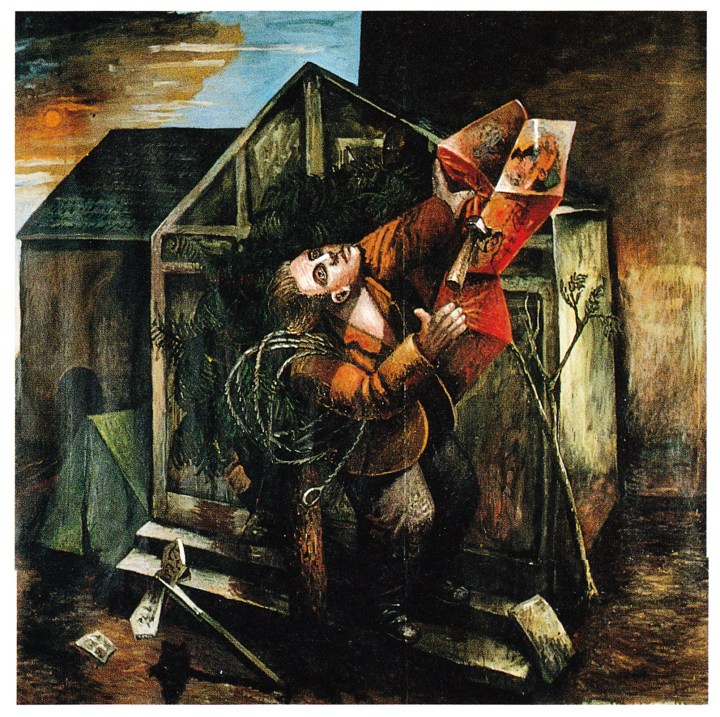
image-18-walking-blue

Steven Campbell – Exploring Illusion

07
Steven Campbell – The Man who Climbs Maps

I think I became less interested in art, conceptual versus figurative, that kind of thing, and I became more interested in thinking about why things are the way they are’ – Steven Campbell.

Steven Campbell’s work displays a persistent fascination with illusion and the levels of reality that exist within a painting. By their nature, figurative paintings are flat and static, showing fixed and illusory worlds, the subjects trapped in time, caught in the confines of the canvas. As the writer Duncan MacMillan observes, while Campbell’s characters ‘innocently explore the apparent freedom of the world they inhabit, they run up against its limits, and, unconsciously, burlesque the limitations of the painters art and so of life itself.’

In the above painting, The Man who climbs Maps, we see the character of the Lost Hiker. Like so many of Campbell’s characters, the Hiker has strayed from his path, and in desperation, attempts to climb his map as if it were a cliff face.

Here, Campbell invites the viewer to consider the nature of painted space. In the world of painted narrative, everything is two-dimensional and on the same plane of existence: the flat illustrations on the map essentially no different from the surrounding landscape and the Hiker himself. Confused, the character mistakes the map for the territory and embarks on his absurd expedition.

Another interesting detail in this painting is the signpost on the bottom left. Such signposts appear often in Campbell’s work, indicating that the characters are suspended between different places, in a sort of limbo or no-man’s land. They never reach their goal or destination, and are trapped in an illusory world that frustrates them at every turn.

08
Steven Campbell – Young Camper Discovering a Grotto in the Ground

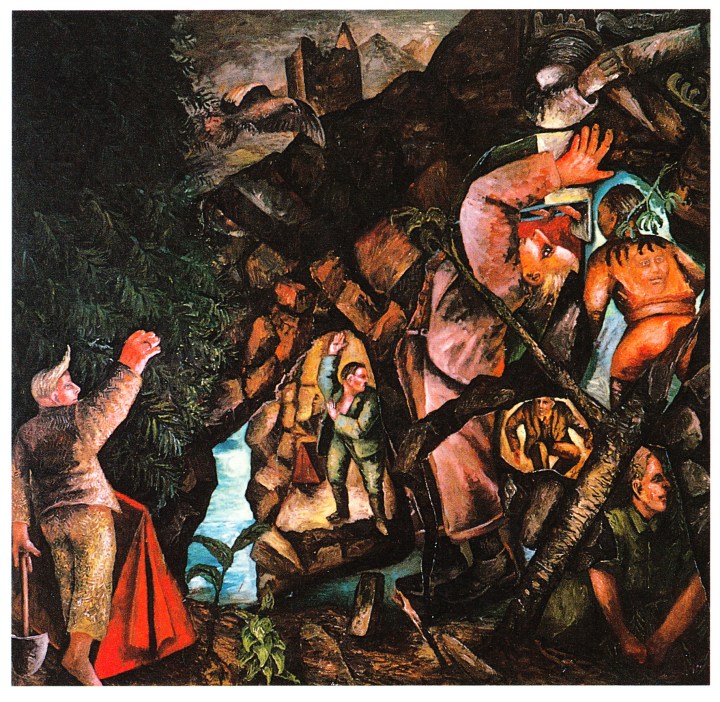
In Young Camper Discovering a Grotto in the ground, Campbell further explores the illusion of painted space. It has seven figures in different scales, and in this crowded painting, we’re not entirely sure who the camper is, and it may in fact be all of them.

The perspective here seems intentionally confusing: we don’t know whether characters are in the background or foreground, and are finally led to conclude that each figure inhabits his own ‘grotto’ of space in the picture-plane. These grottos overlap in a sort of mosaic, confusing the viewer, and apparently confusing the characters themselves. Campbell has taken images that may have made pictorial sense; dismantled, restructured and overlapped them, to demonstrate that representational painters deal only in illusion.

10
Steven Campbell – Not you as well, Snowy

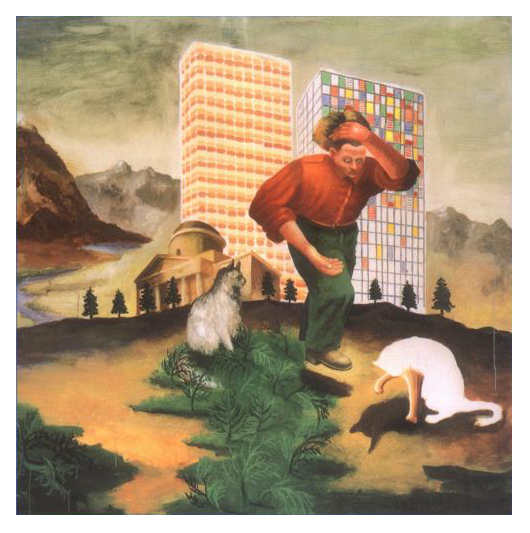
Campbell made this a major theme of his work in an exhibition he had at the Third Eye Centre in Glasgow (now the Centre for Contemporary Art) in 1990. The show questioned received notions about reality, often in a humorous way. In many of the paintings, certain figures or objects were missing, showing only white canvas in the place that they had once been or were intended to be.

The above painting Not you as well, Snowy, shows a young man returning home to see that his cat has also undergone this horrible metamorphosis, snatched from reality to leave only a blank silhouette in its place. Something which, to us, is only a bit of blank canvas in the middle of the picture plane, becomes the shape of this poor character’s missing cat – snatched away into the ether, leaving only his shadow and his paws. In this disturbing yet humorous way, Campbell questions the reality of our own world.

Sources used in this blog post: The Paintings of Steven Campbell, by Duncan MacMillan (p.27, 36, 37 & 65). If you’re wanting to find out more about the work of Steven Campbell, I’d highly recommend getting this Duncan MacMillan book, which looks at Campbell’s work in a great deal of depth.

For other posts about Steven Campbell, please visit Claire Paterson’s WordPress page:

https://clairepatersonartist.wordpress.com

Steven Campbell New York Scholarship

The Saltire Society in conjunction with the Steven Campbell Trust have recently announced the recipient of the first New York Scholarship at the Arts in Public Places Awards in Edinburgh. Claire Paterson, a Graduate of Glasgow School of Art, was successful in being selected for the £13,000 bursary which will see her take up a residency with the prestigious International Studio and Curatorial Programme (ISPC) in Brooklyn. As well as admiring Claire’s work the judges were impressed with her professionalism and her commitment to collaboration which was a key part of her proposal.

The judges stressed the extremely high quality of the entrants and the difficulty in coming to a decision. Artist’s selected for final interviews were: Rory Price, Mark Doyle, Robert Powell and Michael White. All received a cash sum towards art materials as recognition of their work.

The collaboration with the Steven Campbell Trust, which was founded in memory of renowned Glasgow-born artist Steven Campbell, is part of the Saltire Society’s Enlighten programme, launched as part of the Society’s 80th anniversary celebrations.

The Steven Campbell Trust wishes to thank The Saltire Society for their partnership and valued support in this joint venture. We would also like to wish Claire Paterson great success for her forthcoming residency and look forward to following and supporting this exciting initiative in the coming months. Finally, we would like convey our sincere thanks to the high quality of all artist’s interviewed, which made our task in choosing the successful candidate a very difficult one.

We are delighted to highlight selected works from all artist’s concerned below:


Mark Doylehttp://cargocollective.com/markdoyle


5.Forest of Febris-detail
Forest of Febris (Detail).
2.Home is Where the Hot Water is
Mark Doyle, Home Is Where The Hot Water Is
Mark Doyle_Circuit
Circuit


Claire Patersonhttp://www.clairepaterson.com/index.html


Claire 1
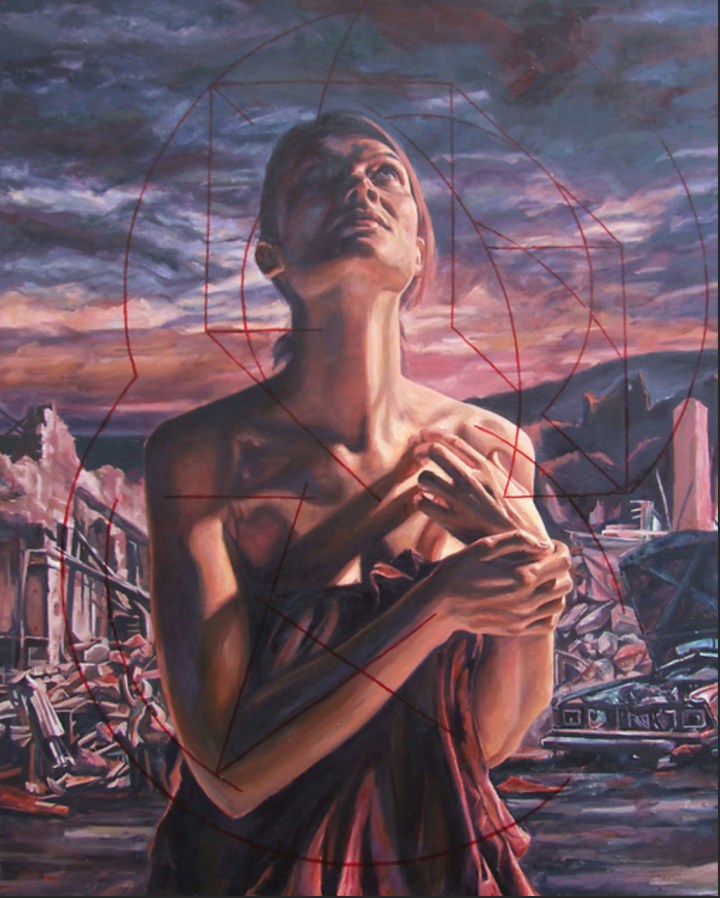
Oriented Toward the Absolute, Oil on Canvas, 79 × 100cm
Claire 2
Becoming Molecular, Oil on Primed Paper, 74 × 53cm
Claire 3
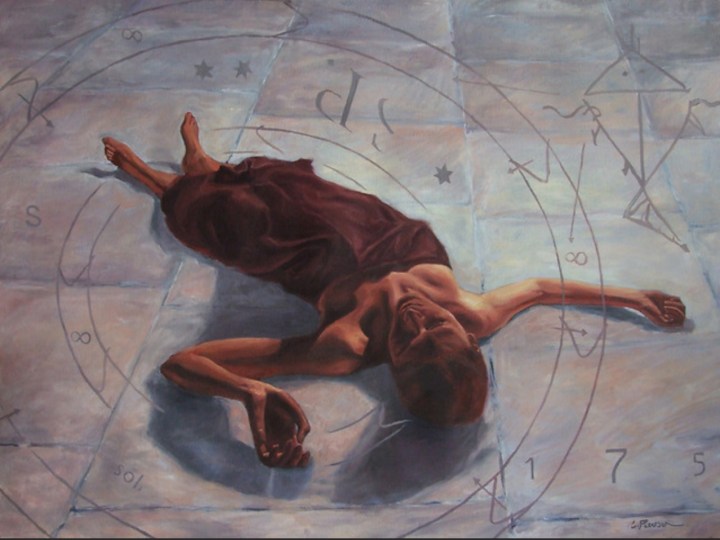
Possible Orientations, Oil on Canvas, 100 x 150 cms


Robert Powellhttp://www.edinburghprintmakers.co.uk/artist/robert-powell


6 Super Mega Duper
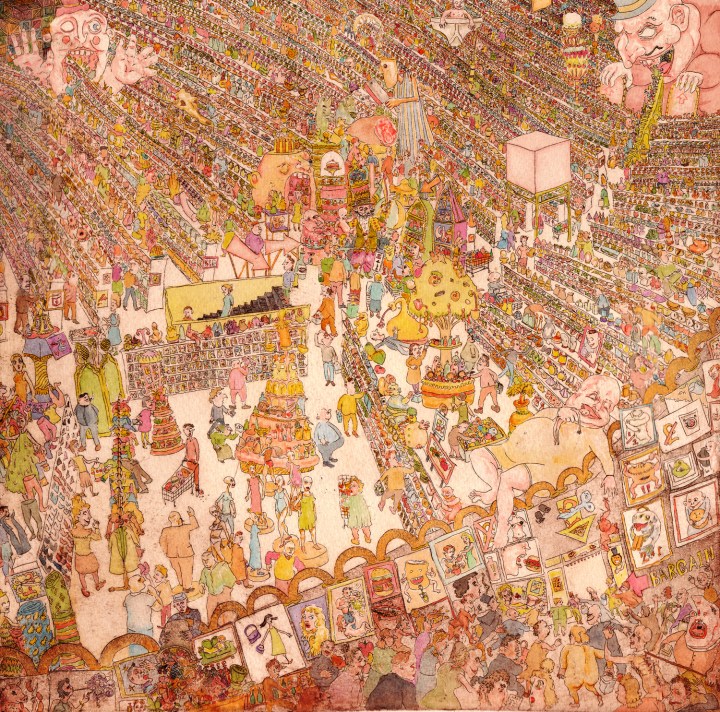
Super Mega Duper, Medium: Hand Coloured Etching
Image Size: 30 x 30 cm
Ikaros School
Ikaros School, Medium: Hand Coloured Etching
Image Size: 30 x 30 cm
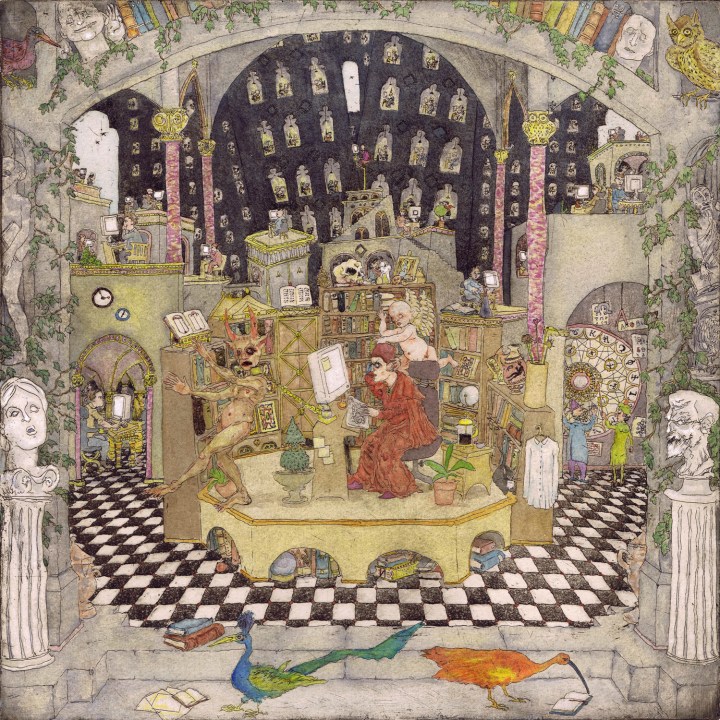
4 The Auktor
The Auktor, Medium: Hand Coloured Etching                                                                                       Image size 30 x 30 cm


Rory Price / http://www.rorywprice.com

cossack-burger-blues_orig
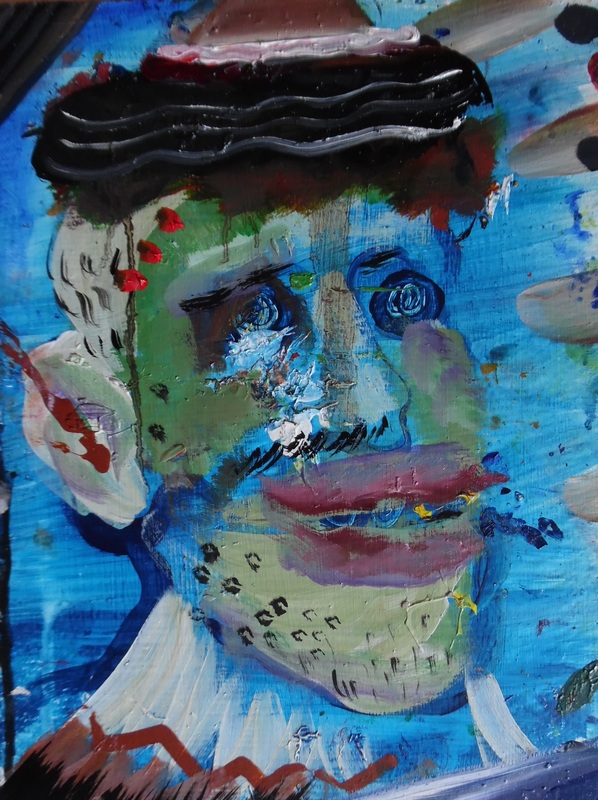
Cossack Burger, Oil on Canvas

8334023_orig

9696193_orig


Michael Whitehttp://www.michaelwhite.org.uk


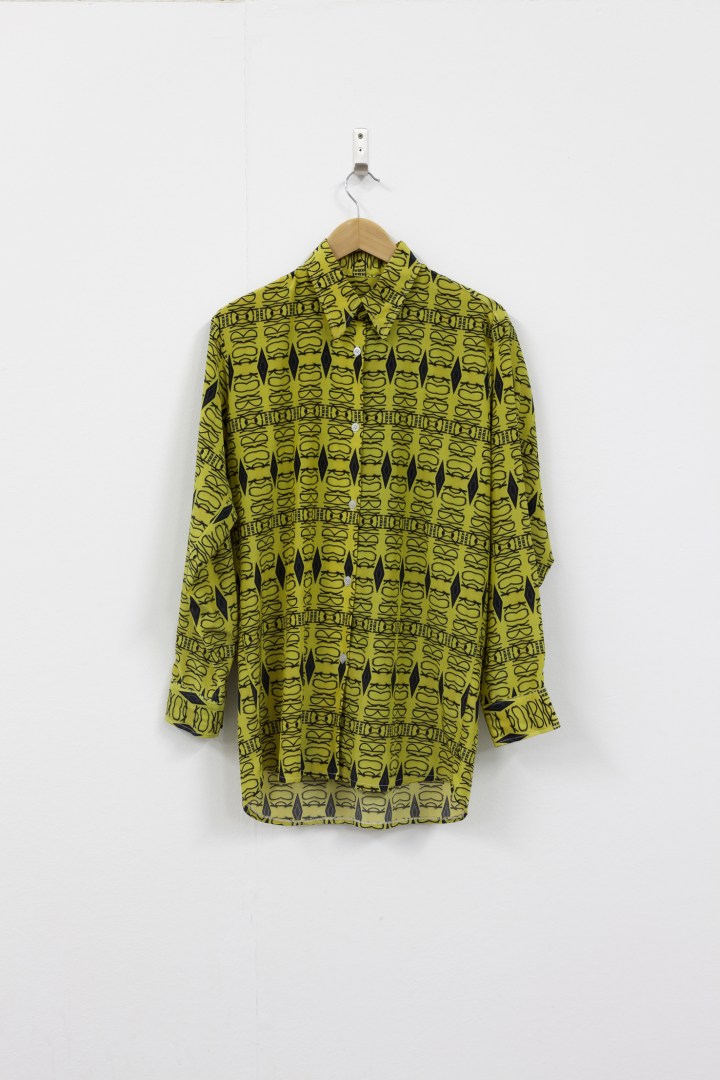
Istanbul - digitally printed silk cotton, wood, stainless steel -  - 90 x 49 x 1cm (2014)
Istanbul – digitally printed silk cotton, wood, stainless steel – 90 x 49 x 1 cm (2014)


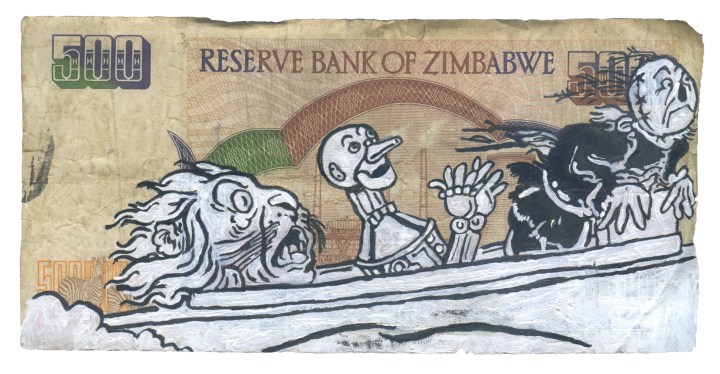
Scarecrow Lion Tinman - Ink and Acrylic on 500 Zimbabwean Dollar bill (2016)
Scarecrow Lion Tinman – Ink and Acrylic on 500 Zimbabwean Dollar bill (2016)


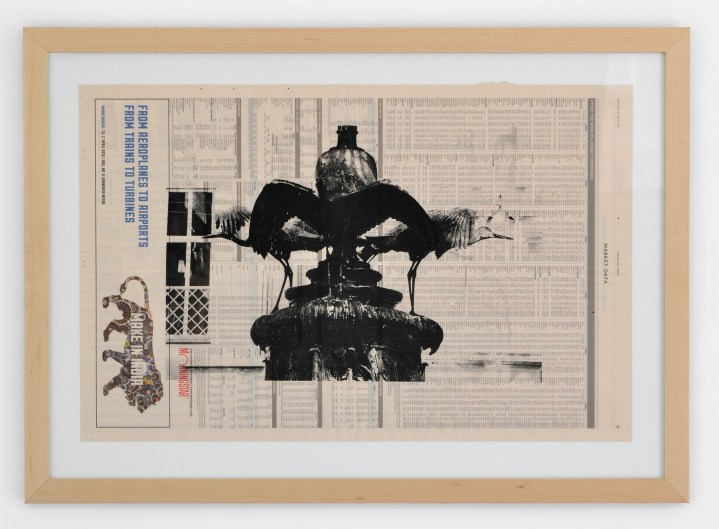
Stork Fountain - Screen Print on Financial Times (2015)
Stork Fountain – Screen Print on Financial Times (2015)


Hunt Medal Winner 2016

Press Release

Felix Carr, Winner of Steven Campbell Trust, Hunt Medal 2016

Statement from Carol Campbell:

“My fellow Directors of the Trust and I had a thoroughly enjoyable visit to the GSA City nights preview last Thursday (16th June) with a view to selecting our Hunt medal winner for this year.

As GSA guidelines require that the prizes given should have a criterion, the selection made by myself and the family was that of ‘Poetic Creativity’ as we felt this encompassed everything that Steven stood for in terms of his Art.

The standard was high and debate was fierce between the Directors but there was a coming together around the work of our choice for 2016 Felix Carr.

Felix’s images were at the forefront of several of our minds during the selection process. We loved the energy, the risk taking and the bravura. So in the end the decision making process was much easier than we had anticipated. We felt we had found a worthy winner in Felix and I am personally delighted to see him awarded the Hunt Medal for 2016.”

To see more of Felix Carr’s work, follow this link

postcard3thumb_IMG_4898_1024_1000
From Series ‘What We Keep Forgetting, Oil on Canvas, ©️ Felix Carr, 2016


IMG_6765
Carol Campbell congratulating GSA graduate Felix Carr on receiving the 2016 Steven Campbell Trust ‘Hunt Medal’ award.

Steven Campbell New York Arts Scholarship

Steven Campbell New York Arts Scholarship

Saltire Society

Deadline: 17 June 2016 at 12:00

The search is on for an aspiring Scottish artist to spend a fully funded three month residency in New York, made possible through a collaborative initiative between the Saltire Society, the Steven Campbell Trust, International Studio and Curatorial Programme (New York) and Creative Scotland.

The scholarship will involve a three month residency as part of the International Studio and Curatorial Programme (ISPC) in Brooklyn. The winning artist will be given dedicated studio space and the unique opportunity to work alongside 45 fellow artists in residence. The winner will also be the first Scottish artist ever to have received a place at this internationally recognised studio.

The Steven Campbell New York Scholarship is part of a wider £50,000 programme of bursaries to support young and emerging Scottish artists, recently unveiled by independent charity the Saltire Society to help celebrate its 80th anniversary year.
The late Steven Campbell is widely recognized as one of the most significant Scottish artists of his generation. Born in Glasgow, Campbell was a student of Glasgow College of Art and went on to gain a Fulbright Scholarship, which he used to go to New York to study at the Pratt Institute before returning to live in Glasgow in 1986. His widow Carol Campbell founded the Steven Campbell Trust following his death in 2007 with the aim of broadening creative thinking and creative output in individuals and communities of practice in a manner which reflects Campbell’s own international outlook and eclectic and imaginative works.

The scholarship is open to graduates from Edinburgh College of Art, Glasgow School of Art, Duncan of Jordanstone in Dundee, Robert Gordon’s in Aberdeen, and Moray College of Art (University of the Highlands and Islands). The scholarship will fund return flights to New York from Scotland, studio fees at ISCP, accommodation costs in New York and a contribution towards living expenses.

Completed applications must be sent to saltire@saltiresociety.org.uk no later than 12 noon on 17th June 2016.

The successful applicant will be announced at the Saltire Society’s headquarters in Edinburgh on 11th August 2016.

Based on advice from ISCP as to the artists who may benefit most from this experience, the Scholarship is aimed at people having graduated between 2004-2012 inclusive. Applicants must be available to take up the full period of their residency from 1st November 2016 until the 31st January 2017.

Location: All Scotland ,International

For further information, please contact saltire@saltiresociety.org.uk (saltire@saltiresociety.org.uk), or visit http://www.saltiresociety.org.uk/news/2016/05/16/the-search-is-on

Art UK Website

We are delighted to see Steven’s work featured in the new Art UK website.

Art UK, is the online home for art from every public collection in the United Kingdom.

Previously called the Public Catalogue Foundation, Art UK is a small charity. They work in partnership with 3,000 public collections, the BBC and other organisations to showcase the art the UK owns.

Art UK already features over 200,000 oil paintings by some 38,000 artists. These artworks are in museums, universities, town halls, hospitals and other civic buildings across the United Kingdom. Most of this art is not on public view.

Campbell, Steven, 1953-2007; Outside Right at the Sunset Gate
Campbell, Steven; Outside Right at the Sunset Gate; The Stirling Smith Art Gallery & Museum; http://www.artuk.org/artworks/outside-right-at-the-sunset-gate-127019


Painting of The Month, March 2016

A Blind Man Would Have Great Difficulty Looking at Cezanne

013 A blind man would have great difficulty with 2001_2 fl

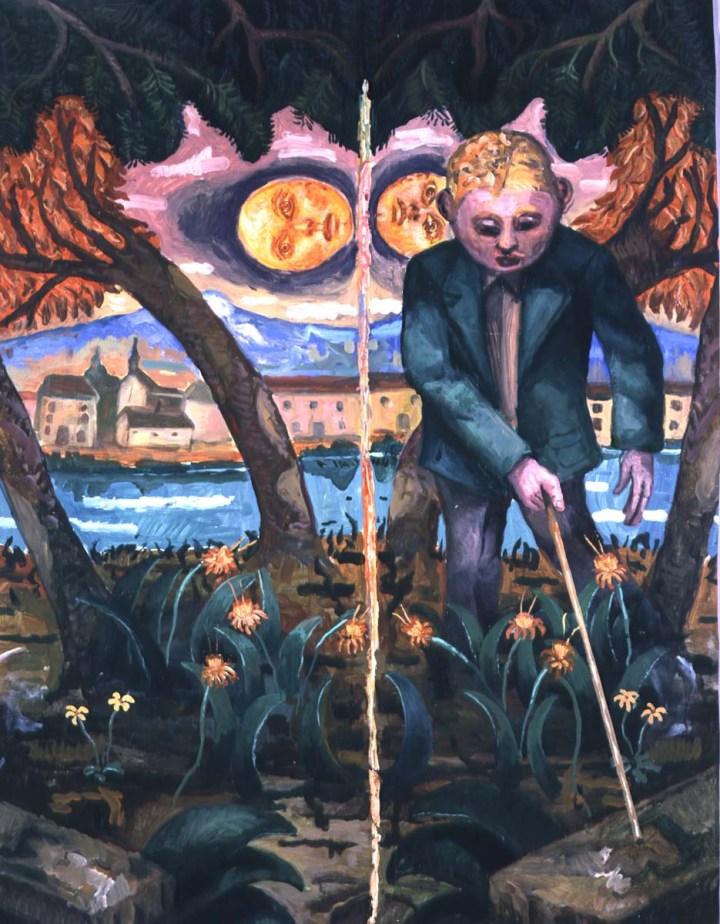
Although a deceptively simple painting, it has a natural beauty with a real sense of place albeit quite surreal.

The background scene is a little town on the bank of the river Saone called Tournus, where we would stop over on route to holidays in Italy. In fact, the family still do, to this day. My grandson Nathan and I will be there this summer.

The journey would progress from Tournus to Aix en Provence, the home-town of Steven’s best-loved artist Cezanne and a pilgrimage to the Jas de Bouffan studio would always be undertaken.

The title of the painting is in relation to that trick of the eye practiced by Cezanne and probably most artists, Steven included of looking at the painting, closing one eye opening it and then quickly closing the other, a sort of winking technique or simply keep one eye closed while looking at an object, scene etc.

“Artists have long known there are two ways of seeing the world”, says University of Oslo Psychology Professor Stine Vogt, Ph.D. “Without learning to turn off the part of the brain that identifies objects, people can only draw icons of objects, rather than the objects themselves. When faced with a hat, for instance, most people sketch an archetypal side view of a hat, rather than the curves, colours and shadows that hit our retina.”

She found that artists eyes tended to scan the whole picture, including apparently empty expanses of ocean or sky while non-artists focused in on objects, especially people. Non-artists spent about 40 percent of the time looking at objects while artists focused on them 20 percent of the time”

So, as the title clearly states, a blind man would have great difficulty with Cezanne.

Carol Campbell 2016

Source: How artist’s see


Discovering Steven Campbell, from Cover to Cover.

I knew in 2004, when I first started university that I wanted to create figurative paintings that were of an imaginative style. I’d studied art all through my education, buying numerous books on the Old Greats. It wasn’t until my foundation course tutor, Mick Maslen, introduced me to the artwork of a group of Scottish figurative painters that I really knew the type of artwork I wanted to create. One of those artists was Steven Campbell.

My tutor handed me the book, ‘The Paintings of Steven Campbell, The Story so Far.’ The paintings inside were totally fresh and new to me. They drew my curiosity as they were full of story, wonder and puzzles. I had always read art books but hadn’t really sat down and read a proper book since school. As I discovered Campbell’s love of the books of P.G Wodehouse I thought by reading them I would find more clues to his paintings. I was planning a trip to Edinburgh to drop a painting off at a gallery and thought this would be a great opportunity for a read so I bought ‘Carry On Jeeves’ by Wodehouse. The book was full of quirky characters and hilarious stories. I thought these characters could be, on some level, the figures in Campbell’s paintings. This was great, these books were almost a dialogue for the artworks and I began reading more and more of them.

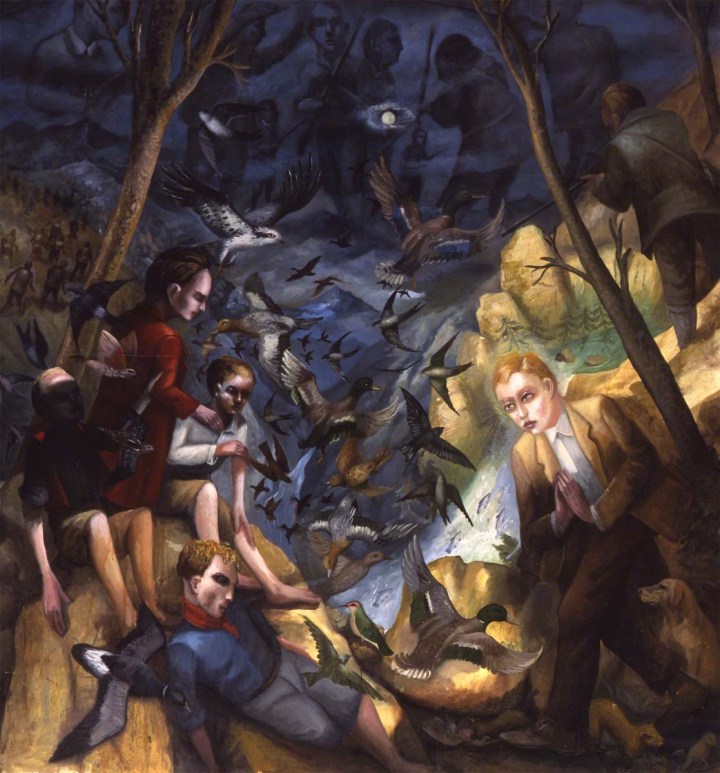
I’ve decided to talk about a painting that was probably the first image of Campbell’s work that I saw. It’s the image used for the front of a book my tutor handed to me. The painting is called ‘Painting in Defence of Migrants.’ Although painted in 1993 the image and subject are actually very appropriate given current events in the world today. The work shows a group of migrants exhausted from their travels, sitting high up next to a waterfall. They are spot-lit; the sky is dark with heavy clouds hanging over them with subtle silhouettes of men with guns drifting among them. Hunters or Soldiers? Perhaps in hot pursuit of the weary travellers?

camp_0034fl
Painting In Defence of Migrants

The composition of the painting is circular, your eye moves around the painting, led by limbs, faces, and nature. Circular? Could this be on purpose to show that the travellers have been walking in circles themselves? Two trees sit either side of the painting, sheltering the group. The tall trunks lean towards each other forcing your eye down a valley filled with birds and fish; they too are migrants. The fish swim against the flowing waters of the river. They are most likely as tired as the people, fighting the current. A man with blonde hair is slightly more spot-lit than the others in the group, his hands placed together as though he is praying. The fish and water behind him are glowing. Has his prayer been answered as nature provides the fish that could be the food the travellers need to gain the energy to carry on? He is also the only one standing and is taking a step forward, a hopeful man not willing to give up. The birds swoop and glide over the landscape, littering the sky like the Hitchcock film, but these birds are not menacing. I feel they represent hope, a rescue party!

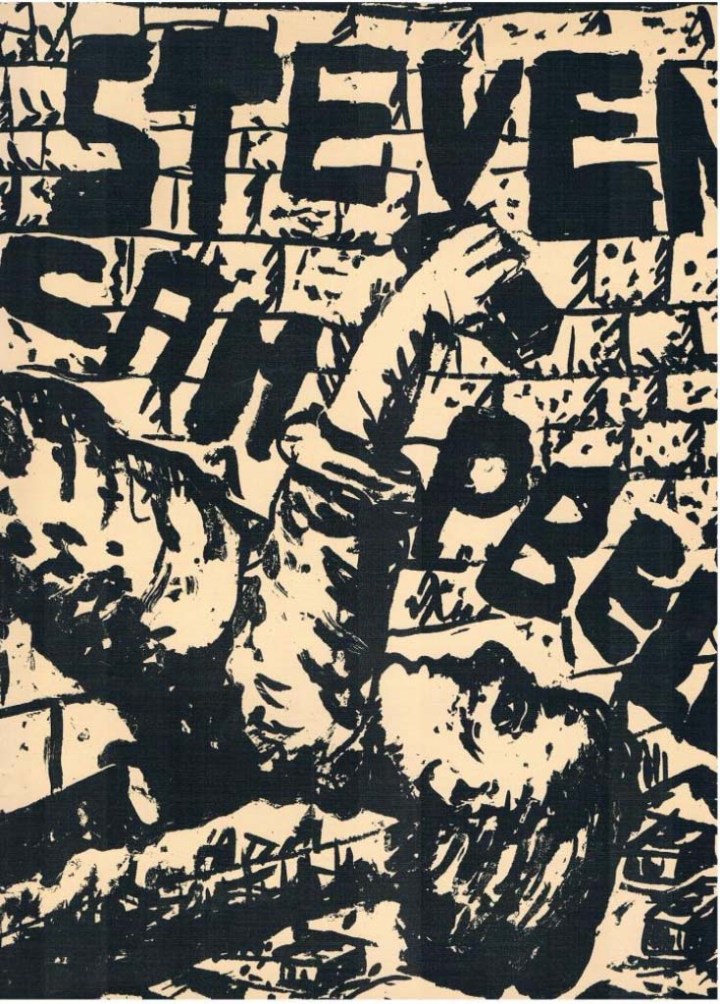
Since first seeing that book I’ve managed to collect a lot of exhibition catalogues of various Steven Campbell exhibitions from various online sellers. My favourite though, is one from a 1984 exhibition at The Fruitmarket Gallery. They say don’t judge a book by its cover but this one had a very special cover. The cover is cream covered with black brush marks crisscrossing and dotting out a horizontal figure in front of brickwork with the name STEVEN CAMPBELL spelled out boldly. As I picked it up I thought the rear of the cover was ripped, only to discover this was purposely done to reveal a pale blue sky with those same expressive black brush marks shaping out a mountain scene.

campbell

The great thing I’ve found in Campbell’s work is that every time I return to look at his paintings I’ll find something new. I feel like a traveller myself when I study them as I’m sure he was when he painted them. One of the things that really draws me to the work is how much you can tell he enjoyed painting these artworks; it’s his playground with endless possibilities.

With thanks to:

Richard Woods

Artist and Damien Hirst Painting Assistant
Member of Steven Campbell Appreciation Group:

https://www.facebook.com/groups/192622471782/


Painting of The Month, January 2016

Tyson Boxing T shirt as Landscape with my Shirt.

camp_0011fl
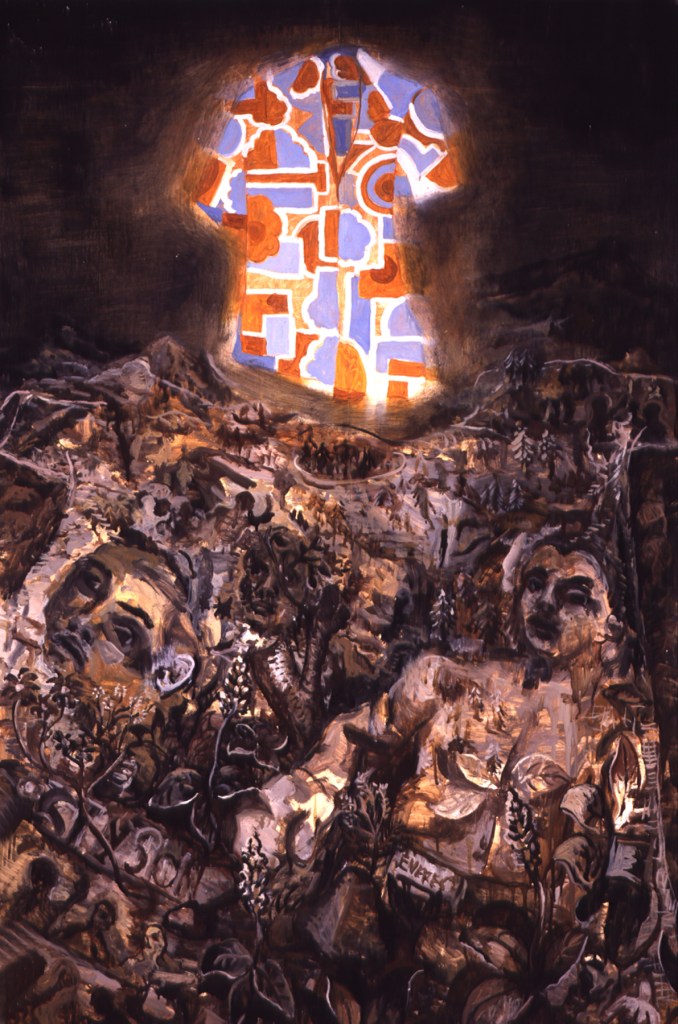
The inspiration for this painting came from a family safari to Kenya. It was just around the time that Mike Tyson was in disgrace, having bit Evander Holyfield on the ear.

We were out one day on route to the game park, traveling through a township market when Steven spotted a black and white printed T shirt featuring Mike Tyson, he got the driver to stop and ran back to buy it.

The t shirt forms the landscape at the bottom of the painting, while Steven’s own holiday shirt (which still hangs in his wardrobe) forms a representation of self while adding another landscape element of sky and sun.

Painting of the Month, December 2015

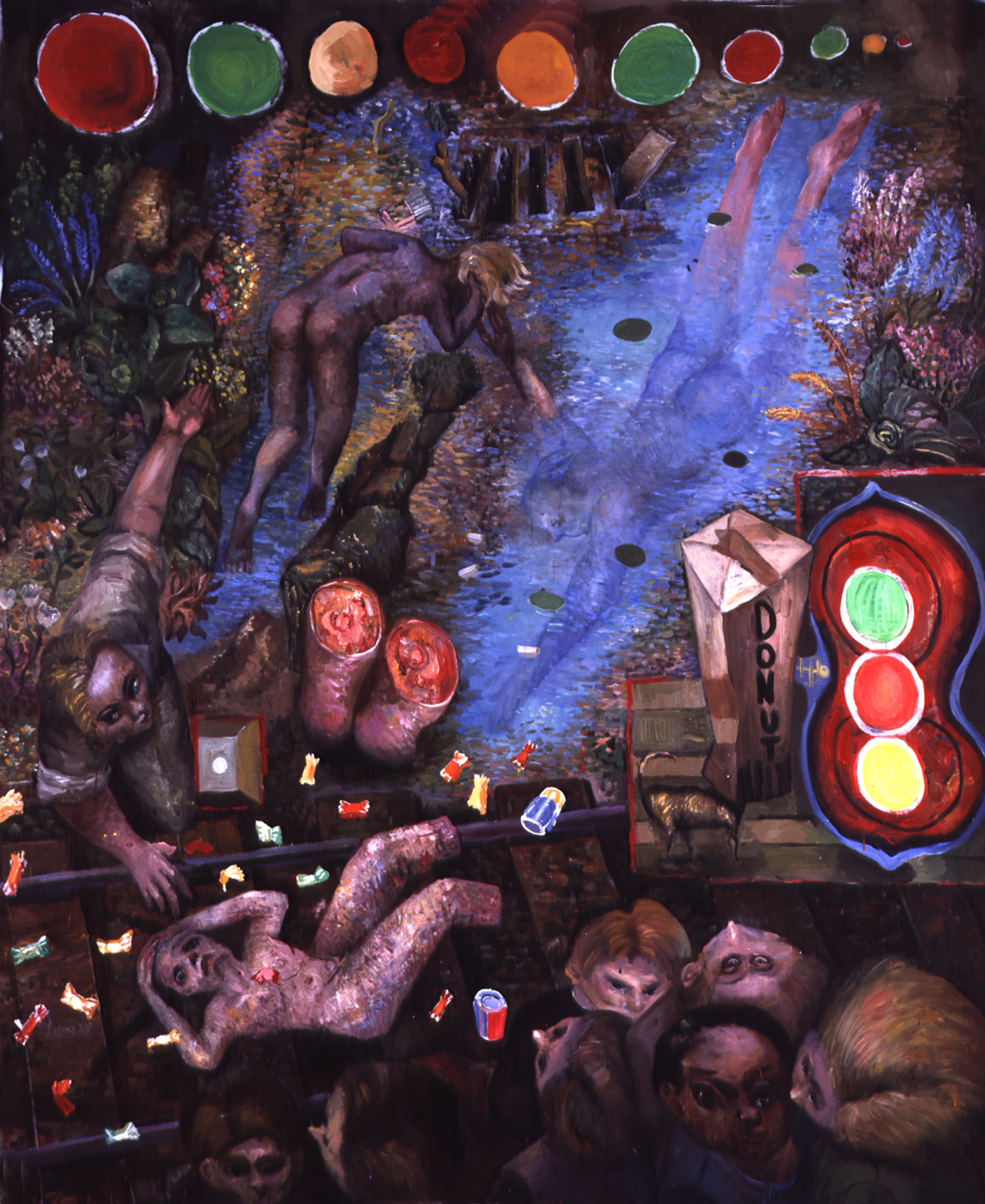
In the Gutter the smells run across the way.

camp_0004fl1

This painting is based on an experience Steven had one Sunday travelling out to his studio in Bed Sty or Bedford Stuyvesant, to give it its full name. He had one change to make on the journey from our loft in Little Italy.

On approaching the platform to continue his journey he found it crowded with people and soon discovered that there had been a suicide attempt (a jumper on the track). Apparently the man was still there with the emergency services so Steven, not wishing to see anything gruesome (unlike the majority of the crowd) went back in the other direction trying to cross to the other platform to return home.

Unfortunately at the same time as Steven was coming down, the paramedics were bringing the injured young black man, who was now screaming and waving two bloody stumps in the air while lying on the stretcher. His legs had been cut off below the knee. So Steven, by trying to avoid being part of the action ended with a ringside seat, which left a very harrowing memory.

So if you look again at the painting you will see the crowds, bottom right, the signal lights, the body with the 2 stumps above it and various bits of detritus floating about.

The donut bag to the right of the picture beside the signal lights has a body of a rat coming out of it and again this comes from an actual memory. This was a different day but Steven has chosen to merge them into the one painting. We were both standing waiting for our local train, the RR, when a donut bag with the back end of a rat sticking out from it came hurtling along the track, the rat had obviously got inside to retrieve a left over piece of donut and had gotten stuck.

This painting is a good example of how Steven would take personal experiences and merge them with imaginative elements to form a cohesive, if somewhat illusive whole.

A still from a movie, where you write the script with your own imagination.